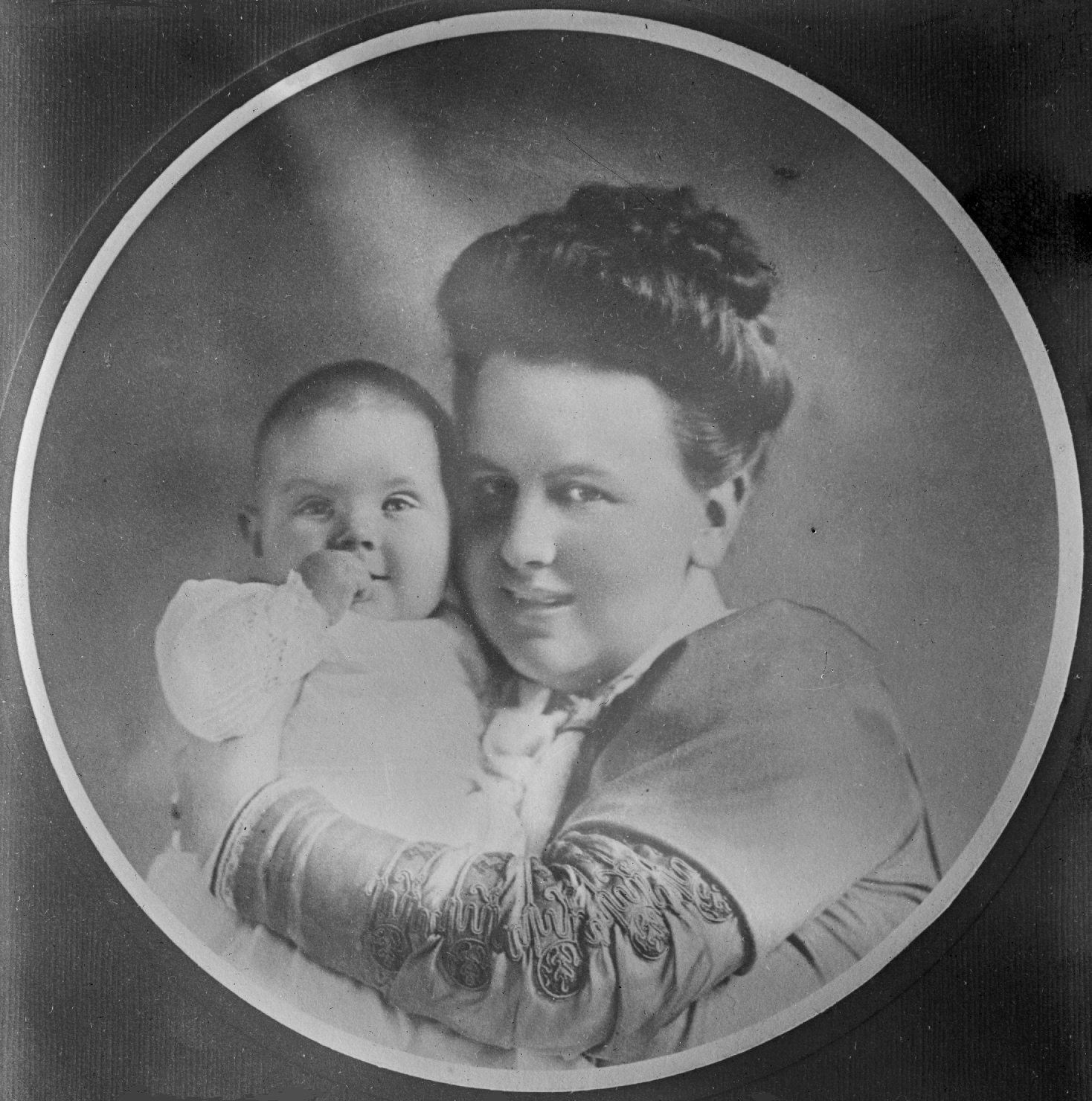
In honor of Mother's Day in the U.S., I have decided to highlight a millennium of royal moms, with one mother from each of the last 10 centuries. Who makes your list?
12th Century: Eleanor of Aquitaine
Children: Two daughters by Louis VII of France; Five sons and three daughters by Henry II of England
 Cats may have nine lives, but Eleanor had at least six. Surviving more than twice as long as her contemporaries, her life spanned nearly the entire century and crept into the next. As a teen, she became Duchess in her own right of the powerful and rich land of Aquitaine. Then, she had a miserable marriage with King Louis VII of France. Lusty and warm-blooded she tricked the devout and rather chaste Louis into a divorce, so that she could marry the younger, more masculine and randy future King of England, taking her lands with her and shifting the balance of power in Europe. Later, she joined her sons in rebellion against King Henry for which he imprisoned her for 16 years. After his death, she was a guiding power during the reign of her favorite son, King Richard the Lion Heart. Then, after his death, she helped secure the throne for her youngest son, thereby sealing the fate of a grandson who had a stronger dynastic claim. At 77, she traveled across the Pyrenees to bring back her Spanish granddaughter to marry her to the French king in an attempt to help bring peace between the countries she had set against each other.
13th Century: Blanche of Castile
Children: Three daughters and ten sons by Louis VIII of France
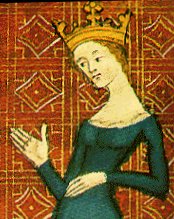 The mother of two saints (St. Louis and St. Isabelle of France), Blanche was the very granddaughter Eleanor of Aquitaine escorted across the mountains. Widowed before she was 40 (and with the first five of her young children already dead), Blanche became Regent of France and defended her son's inheritance against both French nobles and her English cousin, King Henry III. After Louis IX came of age, Blanche remained close to him, often intervening in his marriage and in politics. When he went on Crusade, she once again assumed the Regency and held power until her death four years. In recent decades, Blanche has become a key figure in the Holy Blood/Holy Grail myths regarding a bloodline of descendants of Jesus, which inspired "The Da Vinci Code." According to these tails, it was Blanche who hid documents at Rennes-le-Chateau to protect the holy secret. (For more about Blanche, read my profile of her daughter-in-law Marguerite of Provence.)
14th Century: Katherine Swynford, Duchess of Lancaster
Children: Two daughters and one son by Sir Hugh Swynford; one daughter and three sons by John of Gaunt Duke of Lancaster
In an age when marriage was more about property than romance, Katherine de Roet Swynford found both through her illicit love affair and later marriage to a king's son. Raised among the royal court of the English queen Philippa of Hainault, Katherine likely knew her future husband as a child. When the queen arranged an appropriate marriage for her and Katherine's dutiful attitude later earned her a role as governess to John of Gaunt's daughters by Blanche of Lancaster. This tight weave of court circles is further underscored by the fact that a famous tribute to Blanche, the poem "My Last Duchess," was written by Katherine's brother-in-law, who just happened to be Geoffrey Chaucer. After Blanche's early death, Katherine and John embarked on a love affair that did not prevent him from making a political marriage with the Spanish Princess Constance of Castile. All four of Katherine's children by John were born during his second marriage. Given the surname Beaufort, they were all legitimized when the couple final married after Constance's death. Greatly favored by the royal family, Katherine was granted property of her own and managed it prosperously. The Beauforts played a critical role in the Wars of the Roses, and the Tudor dynasty is descended directly from them.
15th Century: Isabella Queen of Castile
Children: Five daughters and two sons by Ferdinand King of Aragon
With many ferocious and famous moms (including Margaret Beaufort, Catherine of Valois, Margaret of Anjou and Elizabeth Woodville) Isabella emerged as my choice because she was a queen in her own right, she remains internationally well-known, and by golly she personally led her troops into battle even when she was pregnant. Granted, she didn't fight, but just riding along was pretty difficult work even without the complication of pregnancy. Most famous for funding Columbus' voyage to the New World and sparking Spain's rapid rise to riches and power for the next several centuries, Isabella was also fiercely religious. Together, she and her husband were known as The Catholic Kings. In fact, having united most of Spain's warring territories through their marriage, they focused their battles against those of other faiths, pushing the Moors out of southern Spain where an Islamic culture had flourished for centuries bringing artistic and scientific progress. They were also the founders of the Spanish Inquisition, which persecuted Jews, Muslims and, later, some Protestants. Despite efforts to secure their joint kingdoms by marrying their children into Portugal, England and the Holy Roman Empire, the deaths first of Ferdinand and then of Isabella left the Spanish empire in the hands of the Hapsburgs for their sons died without issues and their daughters, including Catherine of Aragon and Juana La Loca, all lived rather tragic lives. In 1972, Isabella was named a Servant of God, the first stage in an investigation that could lead eventually to her sainthood.
16th Century: Catherine de Medici
Children: Five daughters and five sons by Henry II of France
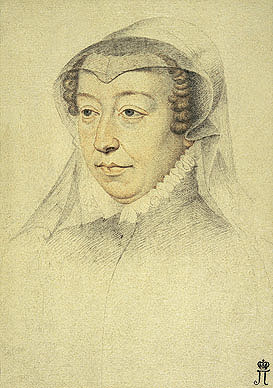 At a time when child mortality rates were very high, it was still unusual for a woman to outlive nine of her children. Born into a tremendously rich and powerful but barely noble Italian family, the teenaged Catherine's marriage to the future French king secured higher status for her family. Orphaned as an infant, she was bounced among family members as a political pawn and even spent three years in a convent before being sent to France. Here, she continued to suffer due her husband's very public preference for his mistresses, including Diane de Poitiers. In essence, Catherine had no role except as his brood mare, a role she failed at for the first 10 years of her marriage. She finally came into her own when Henry's death thrust her into the role of Regent for their son King Francis II and then for their son Charles IX. When yet another son, Henry III, acceded, Catherine continued to exert her influence. She came to power during the violent religious and political struggles of the Reformation. Her early softness toward Protestants eventually hardened and she is often held responsible for the St. Bartholomew's Day Massacre that killed thousands. With the death of her youngest son and the infertility of Henry III, Catherine knew that the Catholic kingdom she had fought so long to preserve would eventually cede to her Protestant son-in-law Henry of Navarre. She could not have foreseen, however, that Henry would convert and end the religious wars, saying "Paris is worth a Mass."
17th Century: Anne of Austria
Children: Two sons by Louis XIII of France
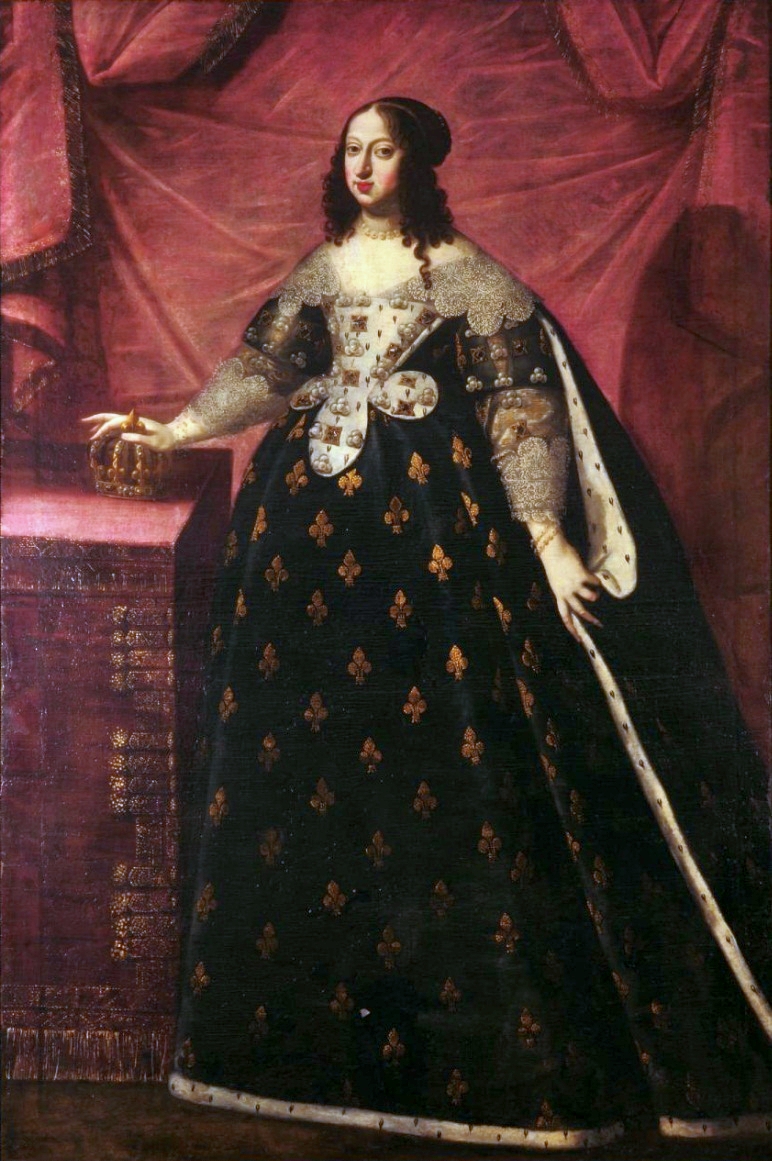 Having suffered several miscarriages, Anne finally gave birth to a living child, the future Sun King, Louis XIV, when she was 37. Anne was always very nurturing, having acted as mother to her younger siblings from the age of 10 when their mother died. Childless for the first 23 years of her marriage, she was never close to her husband or to her mother-in-law, Marie de Medici, whom he overthrew from her Regency when he and Anne were just 16. When Louis brought Cardinal Richelieu to power, Anne was further alienated by his policies against her family, the Hapsburgs--her letters home were always opened and read. Despite Richelieu's death, Louis tried to prevent Anne from becoming Regent when he died, but he failed. Anne took power in the name of her four-year-old son and soon installed Cardinal Mazarin at the head of the government. When Louis XIV came of age, her power began to fade and the death of Mazarin left the young king fully in control 10 years later. Anne eventually retired to a convent and died of breast cancer when she was 64. She is remembered today for fictional portrayals of her in the various novels, plays, and movies about the Three Musketeers.
18th Century: Maria Theresa Empress of Austria
Children: Eleven daughters and five sons by Francis I Holy Roman Emperor
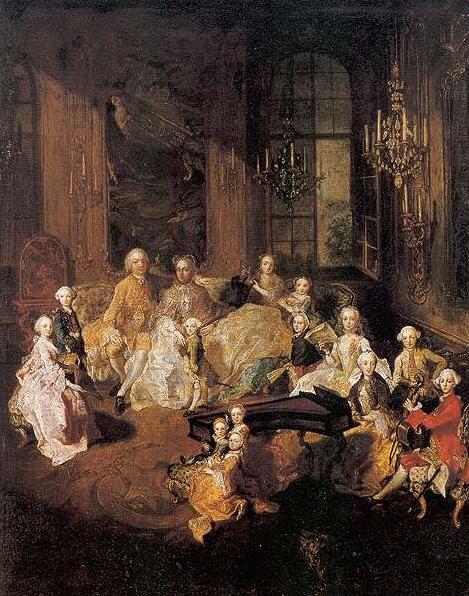 If Queen Victoria is the materfamilias of the 19th century, Maria Theresa holds the distinction in the 18th, but with nearly twice as many children and considerably more personal power. Like Victoria, Maria Theresa inherited the throne at a young age following a succession crisis that had left no male heirs; unlike Victoria, her succession sparked wars that caused the empire to lose territories. Like Victoria, she was madly in love with her husband and deeply mourned him. Unlike Victoria, she actually shared power with her sons. Despite her very conservative views (which included trying to expel both
Jews and Protestants as threats to the peace), she introduced many
reforms to modernize the military, the treasury, health care, education
and, even, civil rights. Her own personal asceticism was apparently not inherited by most of her 11 daughters, all of whom were named Maria. Among them are the infamously risque Queen Maria Carolina of Naples and the much celebrated Queen Marie Antoinette of France.
If Queen Victoria is the materfamilias of the 19th century, Maria Theresa holds the distinction in the 18th, but with nearly twice as many children and considerably more personal power. Like Victoria, Maria Theresa inherited the throne at a young age following a succession crisis that had left no male heirs; unlike Victoria, her succession sparked wars that caused the empire to lose territories. Like Victoria, she was madly in love with her husband and deeply mourned him. Unlike Victoria, she actually shared power with her sons. Despite her very conservative views (which included trying to expel both
Jews and Protestants as threats to the peace), she introduced many
reforms to modernize the military, the treasury, health care, education
and, even, civil rights. Her own personal asceticism was apparently not inherited by most of her 11 daughters, all of whom were named Maria. Among them are the infamously risque Queen Maria Carolina of Naples and the much celebrated Queen Marie Antoinette of France.
19th Century: Princess Alice of the United Kingdom
Children: Five daughters and two sons by Louis IV Grand Duke of Hesse
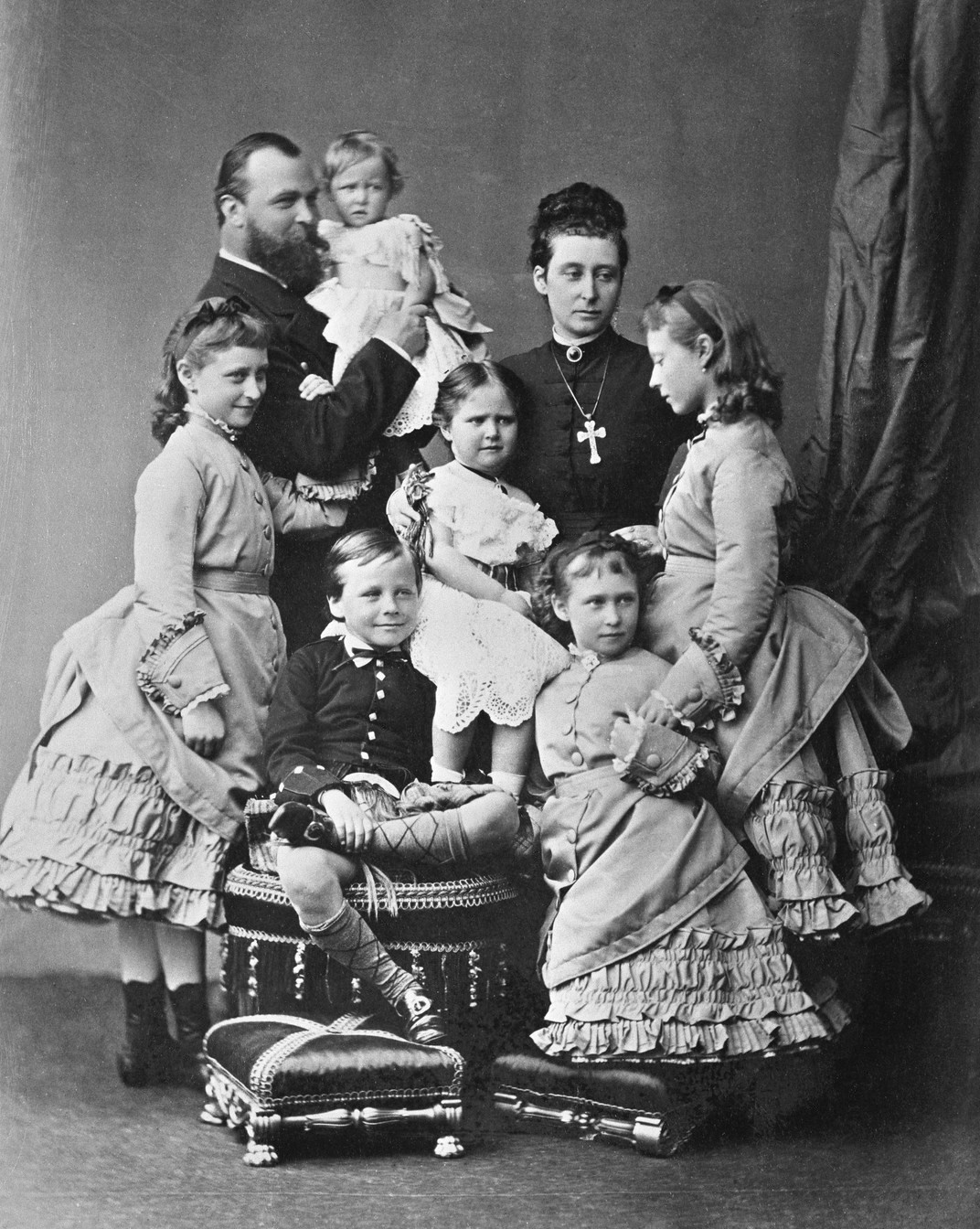 In the century that saw the rise of the modern child-centered family, it is not surprising that innumerable royal ladies were also devoted mamas. For top honors, however, I have selected Queen Victoria's second daughter, Princess Alice. Like her older sister Vicky, Alice ran roughshod over her mother's parenting advice. Admitting that she did not like childbirth--"we are most like animals"--and that "all babies are ugly," The Queen was shocked to learn that Alice was breastfeeding her babies. Alice rejoiced in a hands-on approach that was only just beginning to emerge among the higher classes. Having nursed her father and comforted her grieving mother, Alice married just eight months after Prince Albert's death and was at first deeply homesick and still in mourning, despite the presence of her beloved new husband. Alice soon adjusted to her new life and carved out a role personally caring for the sick and the poor, particularly during the Austro-Prussian War. The role of nursemaid suited her well and she even stayed longer in England once to help her older brother, the Prince of Wales, recover from typhoid. When her youngest son, a hemophiliac fell from a second story window, however, there was nothing she could do to save his life. She was still mourning for him five years later, when the family was struck by diptheria. Only she remained well, and doctors urged her not to touch or cuddle her ailing children. When the baby Maria died, Alice could not restrain herself from comforting the others. She soon contracted the disease and died on the anniversary of her own father's death at the age of 35. Two of her surviving daughters married into the Russian Imperial House: Grand Duchess Elizabeth and Empress Alexandra. Both were murdered in the Russian Revolution and both have since been canonized by the Russian Orthodox Church.
20th Century: Lady Diana Spencer
Children: Two sons by Charles Prince of Wales
 This time, with many royal mothers to choose from, I decided to go with the one who is undoubtedly the most popular. The marriage of Diana and Charles brought new life and renewed interest to the British Royal Family. Although both Prince William and Prince Harry have always been incredibly close to their father, the public regularly credits Diana for their good characters, sense of fun and devotion to good works. While Charles parented largely out of the spotlight, taking them on the royals' usual country retreats to Scotland and Norfolk, Diana introduced them to "ordinary" life with visits to theme parks and fast food restaurants where they were often photographed. When Diana died, she left a huge estate to the boys, which they inherited as adults. Nearly 16 years after losing her, both princes continue to honor their mother publicly. William notably did so when he gave Diana's engagement ring to his bride and Harry most recently drew headlines by mentioning her during his visit to the United States. As the Diana exhibition at Althorp prepares to close down, the princes will become masters of all of those artifacts, materials, and memorabilia. The world is waiting to see what they do with them. Even more hungrily, everyone is waiting to discover whether William will name his child, due in July, for his mother.
21st Century: ???
Children: ???
Just over a decade into the new century, it is impossible to say which royal mother will emerge as the mum of the century--they haven't even all been born yet! To judge by the first decade, perhaps it should be one of the two who have had the most children: with five children each, there are Crown Princess Marie Chantal of Greece and Princess Astrid of Norway, who both started their families in the last century, or with four apiece, there are the Infanta Cristina Duchess of Palma de Mallorca, Princess Mathilde Duchess of Brabant and Crown Princess Mary of Denmark, who pulled it off in just three pregnancies. Or perhaps it should be Crown Princess Masako, who despite a stress disorder that keeps her largely out of the public eye, has continued to mother her only child. Or perhaps it should be Crown Princess Mette Marit of Norway who managed to keep things together as a single mother and still catch a prince, with whom she has had two more children. Or perhaps Sophie Countess of Wessex, who struggled to have each of her children.
Whichever royal moms you celebrate, the women highlighted here are all examples of the ferocious love mothers have for the children and of how women can blend motherhood with careers that can change the world. (For an overview of royal ladies who struggled to be mothers, check out my 2011 post, Always a Monarch, Never a Mother.)
For all of you who are mothers yourself, happy Mother's Day from the Princess Palace.
12th Century: Eleanor of Aquitaine
Children: Two daughters by Louis VII of France; Five sons and three daughters by Henry II of England

13th Century: Blanche of Castile
Children: Three daughters and ten sons by Louis VIII of France
14th Century: Katherine Swynford, Duchess of Lancaster
Children: Two daughters and one son by Sir Hugh Swynford; one daughter and three sons by John of Gaunt Duke of Lancaster
In an age when marriage was more about property than romance, Katherine de Roet Swynford found both through her illicit love affair and later marriage to a king's son. Raised among the royal court of the English queen Philippa of Hainault, Katherine likely knew her future husband as a child. When the queen arranged an appropriate marriage for her and Katherine's dutiful attitude later earned her a role as governess to John of Gaunt's daughters by Blanche of Lancaster. This tight weave of court circles is further underscored by the fact that a famous tribute to Blanche, the poem "My Last Duchess," was written by Katherine's brother-in-law, who just happened to be Geoffrey Chaucer. After Blanche's early death, Katherine and John embarked on a love affair that did not prevent him from making a political marriage with the Spanish Princess Constance of Castile. All four of Katherine's children by John were born during his second marriage. Given the surname Beaufort, they were all legitimized when the couple final married after Constance's death. Greatly favored by the royal family, Katherine was granted property of her own and managed it prosperously. The Beauforts played a critical role in the Wars of the Roses, and the Tudor dynasty is descended directly from them.
15th Century: Isabella Queen of Castile
Children: Five daughters and two sons by Ferdinand King of Aragon
16th Century: Catherine de Medici
Children: Five daughters and five sons by Henry II of France
17th Century: Anne of Austria
Children: Two sons by Louis XIII of France
18th Century: Maria Theresa Empress of Austria
Children: Eleven daughters and five sons by Francis I Holy Roman Emperor
19th Century: Princess Alice of the United Kingdom
Children: Five daughters and two sons by Louis IV Grand Duke of Hesse
20th Century: Lady Diana Spencer
Children: Two sons by Charles Prince of Wales

21st Century: ???
Children: ???
Just over a decade into the new century, it is impossible to say which royal mother will emerge as the mum of the century--they haven't even all been born yet! To judge by the first decade, perhaps it should be one of the two who have had the most children: with five children each, there are Crown Princess Marie Chantal of Greece and Princess Astrid of Norway, who both started their families in the last century, or with four apiece, there are the Infanta Cristina Duchess of Palma de Mallorca, Princess Mathilde Duchess of Brabant and Crown Princess Mary of Denmark, who pulled it off in just three pregnancies. Or perhaps it should be Crown Princess Masako, who despite a stress disorder that keeps her largely out of the public eye, has continued to mother her only child. Or perhaps it should be Crown Princess Mette Marit of Norway who managed to keep things together as a single mother and still catch a prince, with whom she has had two more children. Or perhaps Sophie Countess of Wessex, who struggled to have each of her children.
Whichever royal moms you celebrate, the women highlighted here are all examples of the ferocious love mothers have for the children and of how women can blend motherhood with careers that can change the world. (For an overview of royal ladies who struggled to be mothers, check out my 2011 post, Always a Monarch, Never a Mother.)
For all of you who are mothers yourself, happy Mother's Day from the Princess Palace.