Somewhere in the wee hours of that February morning, a father breathed his last. His one remaining lung finally surrendered to the cancer that had ravaged him for years.
A continent away his daughter woke amidst the sunshine of the Kenyan wilderness, well-rested from a short respite from an otherwise heavy schedule that she had agreed to undertake to give her father a break. Later that day, as her husband walked toward her with a quietness unusual for his athletic and restless spirit, she had no idea that her entire world was about to change. At 25, she was called to bear the heavy mantle of monarchy. One lone figure in a long line of men and women stretching back nearly a millennia.
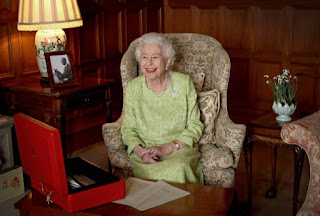 |
The Queen's official Jubilee photo shows her commitment to
work by including the Red Box and underscores her role in the continuity of the Monarchy by including a photo of
her father. Photo by Chris Jackson/Getty Images |
On the eve of her landmark 70th anniversary on the throne, she shared a message that drew a solid line connecting the dots of legacy she inherited so long ago and that she will undoubtedly pass on to the Prince of Wales within the next decade. It is a well-crafted statement underlining her sense of duty and devotion to the wide array of nations she represents and allowing us a glimpse of her most central characteristics, loyalty and service.
Let’s review this beautiful message one section at a time.
Tomorrow, 6th February, marks the 70th anniversary of my Accession in 1952. It is a day that, even after 70 years, I still remember as much for the death of my father, King George VI, as for the start of my reign.
Here The Queen accomplishes two things simultaneously. She links her role as monarch directly to those who have come before her by specifying her immediate predecessor. She also gently reminds us that it is a day of mourning for her. King George VI was darling Papa and trusted mentor. She was a very young woman just four years into her marriage with two toddler children. She imagined a life much more like the one her grandson Prince William has been able to live, pursuing his own interest and raising his children without daily boxes of government boxes. His family life was interrupted but not dominated by royal tours and duties as a young person. Instead her entire life was upended. She paused her family planning, leaving an entire decade between her second child and her third. She watched her husband struggle as he surrendered the ambitions he had in a career he loved to walk behind her for the rest of his life. At an age when most of us still don’t know what we want to be in life, she became the Head of State for millions, a figurehead for even more, and the matriarch of a clan that would be riddled by divorce and tragedy. It is 70 years birthed in her own personal sorrow and sacrifice.
As we mark this anniversary, it gives me pleasure to renew to you the pledge I gave in 1947 that my life will always be devoted to your service.
Once again drawing attention to the deep historical threads that sustain the monarchy, the Queen references the speech she gave from South Africa on her 21st birthday via worldwide radio broadcast. In this oft-quoted speech she said, “I declare before you that my whole life, whether it be long or short, shall be devoted to your service.” Nearly 74 years later, this reminder tells us that she still has no intention of abdicating as has now become somewhat common in other monarchies. Despite much speculation today that she might step down due to her very advanced age, there are two additional facts that may indicate her mindset against the idea. Firstly, the last British abdication, that of her uncle King Edward VIII caused great turmoil in her family when she was only 10 years old. The stress of the responsibilities it placed on her beloved father might very well have shortened his life, as her mother seemed to believe. It also set her on the path to the throne that she might otherwise have avoided had that Uncle instead married a “suitable” woman and had children. Elizabeth might have been a lady in the country with her horses and dogs who showed up on the balcony as a royal cousin a few times a year, no more notable on the world stage than Princess Alexandra is today. Secondly, at the time of her coronation in 1953, Elizabeth took a lifelong vow before God. She is known to have a deep faith that would prevent her from breaking a promise to God.
As I look ahead with a sense of hope and optimism to the year of my Platinum Jubilee, I am reminded of how much we can be thankful for. These last seven decades have seen extraordinary progress socially, technologically and culturally that have benefitted us all; and I am confident that the future will offer similar opportunities to us and especially to the younger generations in the United Kingdom and throughout the Commonwealth.
Here Her Majesty draws upon her role as the nation’s chief symbol of continuity and hope. Despite all the difficulties that have plagued everyone across these seven decades and particularly in the last couple of years, she is using the power of monarchy to do what Winston Churchill noted was the role of her 1947 wedding in the aftermath of World War II; she is bringing a touch of color to the gray by reminding of us all the good that has also happened. As a person of deep person faith, she almost certainly chooses to focus on “hope and optimism”. This is a very different world from that of 1952. The British Empire she inherited is now a Commonwealth of Nations. As the Head of that Commonwealth, she has used her quiet power as a means of change. Politically limited by her role, she has often been subtle but powerful nonetheless, choosing to dance with Black African leaders, driving heads of state from countries that ban women from driving. She has an inner strength and determination that enables her to achieve her own goals with a tenacity that cannot be mistaken. If you doubt this, please refer to her campaign to marry the man of her choice against her father’s better judgment
This section of the message takes the next step forward too, once again underlining The Queen’s responsibility to provide continuity for the nation. She pays homage to the younger generations, encouraging and powering them to pick up the torches that she and others have provided and to carry them into an even bolder, even better future.
I am fortunate to have had the steadfast and loving support of my family.
I was blessed that in Prince Philip I had a partner willing to carry out the role of consort and unselfishly make the sacrifices that go with it. It is a role I saw my own mother perform during my father’s reign.
This anniversary also affords me a time to reflect on the goodwill shown to me by people of all nationalities, faiths and ages in this country and around the world over these years. I would like to express my thanks to you all for your support. I remain eternally grateful for, and humbled by, the loyalty and affection that you continue to give me. And when, in the fullness of time, my son Charles becomes King, I know you will give him and his wife Camilla the same support that you have given me; and it is my sincere wish that, when that time comes, Camilla will be known as Queen Consort as she continues her own loyal service.
These three paragraphs should be considered together as they carry the continuity theme in regards to the Royal Family from the past to present to future. She pays tribute to the support of her family without naming or omitting anyone as some may have thought she should have done. This underscores the role of the Royal Family not just in personally supporting the Monarch but also in publicly supporting the Monarchy.
Then, she speaks specifically about the value of the consort, naming both her own recently passed husband Prince Philip and her mother, the late Queen Elizabeth The Queen Mother. Before moving into the future, she takes an aside to thank the people of all diverse backgrounds for their support as part of a broader human family and to deftly enlist their agreement to what she is about to say. It is here that we get the statement that has come to dominate coverage of this Platinum Jubilee message. For it is here that The Queen gently but unequivocally states her desire that her daughter-in-law Camilla should be called Queen Consort once Prince Charles becomes King. To be clear, there has never been a tradition of the wife of a British King being anything other than Queen Consort, although variations have existed in other countries. A British King’s wife has always been a Queen. This issue only required clarification because the tradition was stood on its head in 2005 when it was announced ahead of Charles and Camilla’s wedding that she would take the title Princess Consort upon his accession. The same announcement shared that she would forego the use of the title Princess of Wales (which is still her title). Many people have presumed the reason for this: out of deference or respect to his first wife Diana or because Camilla did not want to use the same title Diana had used. The truth is that the actual statement gave no reason. Presumably, the decisions about these titles were both made out of a motivation to placate the large segment of the population that despised Camilla for her role in the breakup of Charles and Diana’s marriage. With the passage of time (and the calming of emotion), many have come to realize that there were many issues in that marriage with plenty of “blame” to be had by everyone involved. However, The Queen’s Platinum Jubilee message spotlights the number one reason those decades-old reasons are no longer so important: Camilla’s loyalty and her demonstrated service to the Monarchy, to her husband, and to the nation. Few could argue that Camilla has been anything but an excellent addition to the Royal Family and a great helpmate to Prince Charles. She is pleasant, jolly, and hardworking. She has taken on a range of causes from dog rescues to childhood literacy to osteoporosis. She has steered clear of any controversy in the 30 years since Charles and Diana officially separated. The Queen apparently believes her loyalty and work ethic deserve recognition.
However, many have questioned why this information was included in the Jubilee message. Some have claimed that this distracts from the theme of the celebration, that it distracts attention from The Queen herself or, more radically, that Charles forced her to include it. I think none of these things are true. The Queen has always put The Crown above herself. For her, this Jubilee is about the continuity of Monarchy, not about any achievement that she has made. Remember, for her this Jubilee is a combination of the early loss of her father and her own good fortune of having a long lifespan. By paving the way for her successor to have as smooth a transition as possible, she is ensuring the survival of The Crown, which, to her, is more important than the head that wears it. If the public can come to accept Camilla as a rightful and deserving Queen Consort before Prince Charles becomes King, everything will be less traumatic for the Monarchy.
And so as I look forward to continuing to serve you with all my heart, I hope this Jubilee will bring together families and friends, neighbours and communities – after some difficult times for so many of us – in order to enjoy the celebrations and to reflect on the positive developments in our day-to-day lives that have so happily coincided with my reign.
In this final paragraph, The Queen beautifully wraps up her overarching themes of service, unity, and hope. It is a well-crafted message. One of the most immaculately written that I have ever read. I wish Her Majesty and all of us a joyous celebration. I look forward to her remaining time as Monarch and, with the fullness of time, will likewise celebrate the passing of the Crown to Prince Charles with his Queen by his side.