16 April 2022

Prince Leopold and His Legacy

Young Leopold and Queen Victoria

In the history of royal hemophilia, Prince Leopold was patient zero. His mother, Queen Victoria, longed to wrap in cotton wool and keep him safely near her where she could always keep an eye on him especially after his father Prince Albert died when Leopold was just eight years old. Unlike his brothers, Leopold was not permitted a military career and went instead to university at Christ Church, Oxford. After traveling in Europe, the United States and Canada, where his sister Princess Louise's husband was Governor General, Leopold longed for his own overseas appointment. Victoria would not permit it, keeping him instead as an unofficial secretary for herself, as she had done with most of his five sisters. 

Leopold wanted to be independent and pushed against his mother's restraints. Although he was created Duke of Albany at age 28, tt seemed marriage might be the only true path to escaping Victoria's smothering attention. Even here, though, he was thwarted. Several British brides were rejected and he had trouble settling on a foreign princess until his matchmaking oldest sister Victoria Princess Royal suggested Princess Helena of Waldeck and Pyrmont, whose sister was married to the King of the Netherlands. Both the Queen and Leopold found the lovely and well-educated Helena to be pleasing. Perhaps more importantly, Helena was willing to marry a man whose very life could be in danger every time he banged his knee or bumped his head.

The couple married in April 1882 and were soon able to surprise the Queen with Helena's pregnancy. Although Victoria had presumed that fatherhood was not a real possibility for him, the birth of little Princess Alice of Albany nine months after the wedding proved something of a miracle. By the end of that year, they shared the news that Helena was expecting yet again. The happy couple were delighted with their growing family, but Leopold's health concerns, which also included a mild form of epilepsy, were not improving. As had happened before, his doctors advised him to seek a warmer climate as a refuge from the British winter which caused great pain in his joints. With Helena's advancing pregnancy, she stayed behind with their baby daughter while her husband traveled to Cannes.

The Duke & Duchess of Albany
photo by John Thomson via Wikimedia Commons


Leopold stayed at a private home called Villa Nevada. It seemed a safe enough place for the young man, but his hemophilia could make almost any accident deadly. His nephew, Prince Friedrich of Hesse, had died a decade earlier when the toddler suffered an accidental fall while playing with his brother. The warmth of the south of France could not protect Leopold from an accidental slip on the stairs. After banging his knee and his head, the 30-year-old prince knew the routine. Although he had no external injuries, he went immediately to lie down in hopes of thwarting any potential internal bleeding. Since hemophilia prevented his blood from clotting, his condition rapidly deteriorated. By the next morning, he had bled to death from an apparent cerebral hemorrhage.

Queen Victoria had tried to keep Prince Leopold close to her. She was devastated to lose him so far away. Princess Helena, a widow at 23, carried on with resiliency. Their son, Prince Charles Edward, the new Duke of Albany was born four months later. Helena earned Queen Victoria's great admiration and respect as the young woman focused not just on her own children but also on endeavors related to the arts and health care. She survived Leopold by nearly four decades, passing away after a heart attack in her early sixties.

Prince Charles Edward was selected as the heir to Saxe-Coburg, the princely inheritance of his grandfather Prince Albert's family. This separated him as a teenager from his mother and sister in England. When the first World War came, it also put him on the "wrong side". As a result the Albany title has been abeyance for over a century although he has many descendants alive today, including the King of Sweden and his sisters.

Princess Alice of Albany with her children
May and Rupert
photo by Bain News Service via Wikimedia Commons
Hemophilia, however, did not leave the Albany family tree with Leopold's death. Since it is carried on the X gene, it always passes from a hemophiliac father to any daughter he might have. Since Princess Alice inherited a healthy X gene from her mother, she did not suffer the condition herself - women rarely do since they would have to inherit it from both parents. She married Prince Alexander of Teck, brother of Queen Mary. In the great re-titling of 1917 to rid the British royals of German names and titles, Alexander was created Earl of Athlone with the surname Cambridge. The couple and their children remained close friends of their royal relatives on the throne. Their second son, Maurice died as an infant so it is not clear whether she passed the hemophilia gene to him. Their first son, Rupert Viscount Trematon definitely inherited the condition that had caused Princess Alice to grow up without her father. 

Just before his 21st birthday, Rupert and two friends crashed their car into a tree in France. One friend died quickly while the other survived. Rupert was rushed to hospital with a small skull fracture. It took two weeks for him to bleed to death from cerebral hemorrhage, the same kind of bleed that had killed his grandfather. 

Leopold's legacy carries on in the descendants of Alice's daughter Lady May, who married Sir Henry Abel-Smith, and the Saxe-Coburg family. The boy who Queen Victoria tried so hard to keep close to home now has dozens of descendants scattered across Europe.


07 February 2022

Jubilee: A Message about Monarchy

Somewhere in the wee hours of that February morning, a father breathed his last. His one remaining lung finally surrendered to the cancer that had ravaged him for years. 

A continent away his daughter woke amidst the sunshine of the Kenyan wilderness, well-rested from a short respite from an otherwise heavy schedule that she had agreed to undertake to give her father a break. Later that day, as her husband walked toward her with a quietness unusual for his athletic and restless spirit, she had no idea that her entire world was about to change. At 25, she was called to bear the heavy mantle of monarchy. One lone figure in a long line of men and women stretching back nearly a millennia.


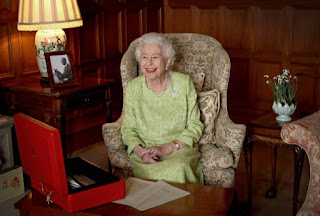
The Queen's official Jubilee photo shows her commitment to work by including the Red Box and underscores her role in
the continuity of the Monarchy by including a photo of her father.
Photo by Chris Jackson/Getty Images
Seventy years on, Queen Elizabeth II thinks of her dear Papa on this day when the rest of the world thinks of her. Most of us have never known another British monarch. She has been consulted by 15 British Prime Ministers from Winston Churchill to Margaret Thatcher to Boris Johnson. She has watched 14 American Presidents come and go. And, yet she has remained as steadfast as  the white cliffs of Dover as immediately recognizable as Stone Henge. Despite the heartaches that have troubled her family and broken her own heart, she has emerged now a smiling, peaceful lady whose eyes have witnessed nearly a century of turbulence and progress.

On the eve of her landmark 70th anniversary on the throne, she shared a message that drew a solid line connecting the dots of legacy she inherited so long ago and that she will undoubtedly pass on to the Prince of Wales within the next decade. It is a well-crafted statement underlining her sense of duty and devotion to the wide array of nations she represents and allowing us a glimpse of her most central characteristics, loyalty and service.


Let’s review this beautiful message one section at a time.


Tomorrow, 6th February, marks the 70th anniversary of my Accession in 1952. It is a day that, even after 70 years, I still remember as much for the death of my father, King George VI, as for the start of my reign.


Here The Queen accomplishes two things simultaneously. She links her role as monarch directly to those who have come before her by specifying her immediate predecessor. She also gently reminds us that it is a day of mourning for her. King George VI was darling Papa and trusted mentor. She was a very young woman just four years into her marriage with two toddler children. She imagined a life much more like the one her grandson Prince William has been able to live, pursuing his own interest and raising his children without daily boxes of government boxes. His family life was interrupted but not dominated by royal tours and duties as a young person. Instead her entire life was upended. She paused her family planning, leaving an entire decade between her second child and her third. She watched her husband struggle as he surrendered the ambitions he had in a career he loved to walk behind her for the rest of his life. At an age when most of us still don’t know what we want to be in life, she became the Head of State for millions, a figurehead for even more, and the matriarch of a clan that would be riddled by divorce and tragedy. It is 70 years birthed in her own personal sorrow and sacrifice. 


As we mark this anniversary, it gives me pleasure to renew to you the pledge I gave in 1947 that my life will always be devoted to your service.


Once again drawing attention to the deep historical threads that sustain the monarchy, the Queen references the speech she gave from South Africa on her 21st birthday via worldwide radio broadcast. In this oft-quoted speech she said, “I declare before you that my whole life, whether it be long or short, shall be devoted to your service.” Nearly 74 years later, this reminder tells us that she still has no intention of abdicating as has now become somewhat common in other monarchies. Despite much speculation today that she might step down due to her very advanced age, there are two additional facts that may indicate her mindset against the idea. Firstly, the last British abdication, that of her uncle King Edward VIII caused great turmoil in her family when she was only 10 years old. The stress of the responsibilities it placed on her beloved father might very well have shortened his life, as her mother seemed to believe. It also set her on the path to the throne that she might otherwise have avoided had that Uncle instead married a “suitable” woman and had children. Elizabeth might have been a lady in the country with her horses and dogs who showed up on the balcony as a royal cousin a few times a year, no more notable on the world stage than Princess Alexandra is today. Secondly, at the time of her coronation in 1953, Elizabeth took a lifelong vow before God. She is known to have a deep faith that would prevent her from breaking a promise to God.


As I look ahead with a sense of hope and optimism to the year of my Platinum Jubilee, I am reminded of how much we can be thankful for.  These last seven decades have seen extraordinary progress socially, technologically and culturally that have benefitted us all; and I am confident that the future will offer similar opportunities to us and especially to the younger generations in the United Kingdom and throughout the Commonwealth.


Here Her Majesty draws upon her role as the nation’s chief symbol of continuity and hope. Despite all the difficulties that have plagued everyone across these seven decades and particularly in the last couple of years, she is using the power of monarchy to do what Winston Churchill noted was the role of her 1947 wedding in the aftermath of World War II; she is bringing a touch of color to the gray by reminding of us all the good that has also happened. As a person of deep person faith, she almost certainly chooses to focus on “hope and optimism”. This is a very different world from that of 1952. The British Empire she inherited is now a Commonwealth of Nations. As the Head of that Commonwealth, she has used her quiet power as a means of change. Politically limited by her role, she has often been subtle but powerful nonetheless, choosing to dance with Black African leaders, driving heads of state from countries that ban women from driving. She has an inner strength and determination that enables her to achieve her own goals with a tenacity that cannot be mistaken. If you doubt this, please refer to her campaign to marry the man of her choice against her father’s better judgment


This section of the message takes the next step forward too, once again underlining The Queen’s responsibility to provide continuity for the nation. She pays homage to the younger generations, encouraging and powering them to pick up the torches that she and others have provided and to carry them into an even bolder, even better future.


I am fortunate to have had the steadfast and loving support of my family. 
 
I was blessed that in Prince Philip I had a partner willing to carry out the role of consort and unselfishly make the sacrifices that go with it.  It is a role I saw my own mother perform during my father’s reign. 
 
This anniversary also affords me a time to reflect on the goodwill shown to me by people of all nationalities, faiths and ages in this country and around the world over these years.  I would like to express my thanks to you all for your support.  I remain eternally grateful for, and humbled by, the loyalty and affection that you continue to give me.  And when, in the fullness of time, my son Charles becomes King, I know you will give him and his wife Camilla the same support that you have given me; and it is my sincere wish that, when that time comes, Camilla will be known as Queen Consort as she continues her own loyal service.


These three paragraphs should be considered together as they carry the continuity theme in regards to the Royal Family from the past to present to future. She pays tribute to the support of her family without naming or omitting anyone as some may have thought she should have done. This underscores the role of the Royal Family not just in personally supporting the Monarch but also in publicly supporting the Monarchy.


Then, she speaks specifically about the value of the consort, naming both her own recently passed husband Prince Philip and her mother, the late Queen Elizabeth The Queen Mother. Before moving into the future, she takes an aside to thank the people of all diverse backgrounds for their support as part of a broader human family and to deftly enlist their agreement to what she is about to say. It is here that we get the statement that has come to dominate coverage of this Platinum Jubilee message. For it is here that The Queen gently but unequivocally states her desire that her daughter-in-law Camilla should be called Queen Consort once Prince Charles becomes King. To be clear, there has never been a tradition of the wife of a British King being anything other than Queen Consort, although variations have existed in other countries. A British King’s wife has always been a Queen. This issue only required clarification because the tradition was stood on its head in 2005 when it was announced ahead of Charles and Camilla’s wedding that she would take the title Princess Consort upon his accession. The same announcement shared that she would forego the use of the title Princess of Wales (which is still her title). Many people have presumed the reason for this: out of deference or respect to his first wife Diana or because Camilla did not want to use the same title Diana had used. The truth is that the actual statement gave no reason. Presumably, the decisions about these titles were both made out of a motivation to placate the large segment of the population that despised Camilla for her role in the breakup of Charles and Diana’s marriage. With the passage of time (and the calming of emotion), many have come to realize that there were many issues in that marriage with plenty of “blame” to be had by everyone involved. However, The Queen’s Platinum Jubilee message spotlights the number one reason those decades-old reasons are no longer so important: Camilla’s loyalty and her demonstrated service to the Monarchy, to her husband, and to the nation. Few could argue that Camilla has been anything but an excellent addition to the Royal Family and a great helpmate to Prince Charles. She is pleasant, jolly, and hardworking. She has taken on a range of causes from dog rescues to childhood literacy to osteoporosis. She has steered clear of any controversy in the 30 years since Charles and Diana officially separated. The Queen apparently believes her loyalty and work ethic deserve recognition.


However, many have questioned why this information was included in the Jubilee message. Some have claimed that this distracts from the theme of the celebration, that it distracts attention from The Queen herself or, more radically, that Charles forced her to include it. I think none of these things are true. The Queen has always put The Crown above herself. For her, this Jubilee is about the continuity of Monarchy, not about any achievement that she has made. Remember, for her this Jubilee is a combination of the early loss of her father and her own good fortune of having a long lifespan. By paving the way for her successor to have as smooth a transition as possible, she is ensuring the survival of The Crown, which, to her, is more important than the head that wears it. If the public can come to accept Camilla as a rightful and deserving Queen Consort before Prince Charles becomes King, everything will be less traumatic for the Monarchy.


And so as I look forward to continuing to serve you with all my heart, I hope this Jubilee will bring together families and friends, neighbours and communities – after some difficult times for so many of us – in order to enjoy the celebrations and to reflect on the positive developments in our day-to-day lives that have so happily coincided with my reign.


In this final paragraph, The Queen beautifully wraps up her overarching themes of service, unity, and hope. It is a well-crafted message. One of the most immaculately written that I have ever read. I wish Her Majesty and all of us a joyous celebration. I look forward to her remaining time as Monarch and, with the fullness of time, will likewise celebrate the passing of the Crown to Prince Charles with his Queen by his side.


01 January 2022

No Mercy: The Story of Margaret of Anjou

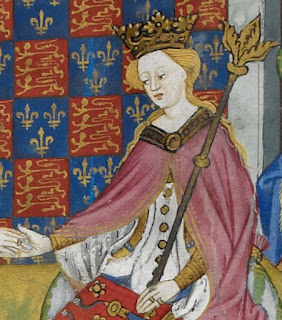
By a Talbot Master via Wikimedia Commons

Margaret of Anjou was seething. She had spent years literally fighting her husband's battles for him, while these two men, William Baron Bonville and Sir Thomas Kyriell, held him captive for Richard Duke of York. Well, Richard was dead now. His head had been displayed on the walls of the City of York by Margaret's forces. Now, she had led the army that had defeated his forces at the Second Battle of St. Albans and she had recaptured her husband, England's King Henry VI. 

The moment called for justice. It called for strength. This was a lesson she wanted her seven-year-old son Edward Prince of Wales to learn firsthand. He would be a strong and effective king one day, unlike his weak and sickly father. "What death shall these men die?" Queen Margaret asked Prince Edward. "Behead them," the little boy commanded. King Henry shrieked his objection. "I promised them amnesty!" 

But, Margaret was in no mood for amnesty. No mercy. These Yorkist had not just usurped her husband's authority; they had attempted to steal her only child's birthright. Indeed, the newly deceased Duke of York had convinced the feeble King Henry that he could keep his powerless crown as long as he made York his heir. This was a crime that Margaret would not forgive.

Margaret had grown up in Lorraine, where her formidable mother was reigning duchess in her own right, and in Provence, where her father was the count. Her father Rene was also the titular King of Naples as well as Sicily and Jerusalem. But it was her mother, not her father, who fought to make those titles real. Foreshadowing Margaret's own future marriage, Rene was being held captive while his wife Isabel fought for his rights. Powerful women were a tradition in Margaret's family: the family's other territory, Anjou, was ruled over by Rene's mother, Yolanda of Aragon, in his stead.

Margaret's marriage at age 15 to the young King Henry VI was meant to bring peace and stability. He was only nine months old when he inherited the English throne from his father King Henry V. Just a month later, the infant Henry inherited his maternal grandfather King Charles VI's French throne, too. Charles' son opposed Henry's claim to the French throne, which had been wrenched from Charles VI after military defeat. He had declared himself King Charles VII and succeeded in asserting his authority. By marrying his now single-throned nephew to his niece Margaret, the power struggle between France and England should have ended but it didn't. Having long since taken personal control after years of having his lands and armies led by regents, Henry was mucking everything up. Soon, Calais was England's last remaining vestige of the Angevin Empire that had been forged by his ancestors King Henry II and Queen Eleanor of Aquitaine. And, all that losing had a negative impact among his lords, too.

Henry was seen as weak and ineffective. His wife seems to have agreed. Despite King Henry's promise of amnesty to the men who had held him captive, Margaret beheaded Bonville and Kyriell. Her victory was short lived. In just a few weeks' time, the Duke of York's son defeated the Lancastrian forces, deposed King Henry and declared himself King Edward IV. 

For Margaret, only her son's future mattered and she would do all that she could to ensure his birthright. She returned to France to seek more support against the new Duke of York, another prince named Edward. She also allied herself with Richard Earl of Warwick, known to history as the Kingmaker. Warwick had been the muscle behind the Yorkist claims, but he had fallen out with Edward IV. He eagerly cast his lot with the Lancastrian Queen Margaret, who even agreed to marry the Prince of Wales to Warwick's daughter, Anne Neville. To ensure the royal match and prove his loyalty, Warwick returned to England and restored King Henry to the throne. Margaret, Edward Prince of Wales and Anne returned to England but the struggle had not ended. Barely six months after Henry's restoration, the Lancastrians were defeated in the Battle of Tewkesbury. Margaret's son, aged just 17, died in the battle (or perhaps in its aftermath). Margaret and Henry were taken into custody separately. Within two weeks, Henry died under suspicious circumstances. As for Margaret, she was left with nothing left to fight for. She was imprisoned in the Tower of London for several years before the French king paid to free her. She survived her last few years on his charity. Even after her death, Margaret could find no peace -- her remains were ransacked by Revolutionaries three centuries later.


More about Margaret of Anjou
A Happy Anniversary to Henry VI and Margaret of Anjou on History Refreshed by Susan Higginbotham
A Letter to Margaret of Anjou on History Refreshed by Susan Higginbotham
Margaret of Anjou on English Monarchs
Margaret of Anjou on Queens College Cambridge
Margaret of Anjou on The Freelance History Writer
Margaret of Anjou: Queen of England, She-Wolf of France on Richard III: A Virtual Dramaturgical Casebook
Margaret of Anjou's Coronation on History Refreshed by Susan Higginbotham
Margaret of Anjou's Last Days: Her Dogs and Her Burial on History Refreshed by Susan Higginbotham
Margaret of Anjou's Supposed Lovers on History Refreshed by Susan Higginbotham
Margaret of Anjou's Will on History Refreshed by Susan Higginbotham
Margaret, the Mother-in-Law from Hell? on History Refreshed by Susan Higginbotham
Medieval Royalty -- Margaret of Anjou on Historic Royal Palaces
Queen Margaret of Anjou on National Portrait Gallery
So What Did Margaret of Anjou Look Like? on History Refreshed by Susan Higginbotham
Speaking of Margaret of Anjou's Marriage on History Refreshed by Susan Higginbotham
Ten Rules for Depicting Margaret of Anjou in Historical Fiction on History Refreshed by Susan Higginbotham