21 May 2010

The Royal “Mrs.”

As has been traditional in the western world, women--even royal women--take their husband's name upon marriage. This includes being called by their husband's first and last name with "Mrs." in front of it. For instance, under this tradition, my mother is "Mrs. David Anderson", a name she only uses when receiving joint mailings with him: "Mr. & Mrs. David Anderson" Otherwise, she uses her birth name and married name: "Gwendolyn Anderson."

For royal women, they take the female version instead of "Mrs." with their husband's first name and title, which is why the statuesque Baroness Marie Christine von Reibnitz is called "Princess Michael." The only exception is if a royal bride outranks her husband. In that case, she may use her husband's name and title, but only after her own: HRH The Princess Royal, Mrs. Timothy Laurence and HRH Princess Alexandra, The Hon. Lady Ogilvy.

Currently, there are six women with the British royal equivalent of “Mrs.” They are titled "Princess" and "Duchess" but only in association with their husband's name, with the exception of one, who has always outranked her husband. She is also the only brunette in the group--the rest are all natural blondes. I guess princes prefer blondes--what does that say for the brunette Kate Middleton's future? (For more on the topic of British royal titles and how they might impact Kate, see Princess Kate! The Duchess of What?)
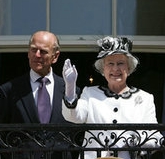
By David Bohrer via Wikimedia Commons
HM The Queen is also The Duchess of Edinburgh since her husband was created a royal duke when they married. However, since she always outranked him as The Princess Elizabeth (the “The” indicating that she was the daughter of a monarch), she was never known as “Princess Philip,” especially since he renounced his title as Prince of Greece and Denmark before they married in 1947. He was not a prince again until his wife made him The Prince Philip (with the most royal “The” included) nearly 10 years later.

By Ibaglivia via Wikimedia Commons
HRH The Princess of Wales, The Duchess of Cornwall, The Duchess of Rothesay. Camilla Parker-Bowles (nee Shand) is married to Prince William’s father, HRH The Prince Charles, The Prince of Wales, who as heir to the English throne has the title The Duke of Cornwall and as heir to Scottish throne has the title The Duke of Rothesay—the two thrones have been merged since 1714. In order to avoid upsetting people who associated “Princess of Wales” with Charles’ first wife, Camilla prefers to be styled HRH The Duchess of Cornwall; and is styled HRH The Duchess of Rothesay when on official duties in Scotland.

By Frankie Fouganthin
via Wikimedia Commons
HRH The Princess Edward, The Countess of Wessex. Formerly Sophie Rhys-Jones, she is married to the Queen’s youngest son who was given the title Earl of Wessex instead of being made a royal duke when they married. It is believed that they requested and/or accepted a lesser title because they didn’t want their children to be burdened with princely titles and because Edward is expected to eventually receive his father’s title, The Duke of Edinburgh. Technically that title would be inherited by The Prince Charles, as the eldest son, but he would likely be glad to give it to his baby brother (there’s a 16 year age difference between them). As for Edward and Sophie’s children, they are still technically HRH Princess Louise of Wessex and HRH Prince James of Wessex, but the Queen agreed to their parents’ request and they are styled as children of an earl: The Lady Louise Windsor and James Viscount Severn (his father’s secondary title).

By The National Churches Trust

via Wikimedia Commons
HRH Princess Richard, The Duchess of Gloucester. Danish-born Birgitte van Deurs is married to the 2nd Duke of Gloucester, a first cousin of the Queen. At the time of their marriage, he was not expected to become a duke, because he had an older brother, HRH Prince William of Gloucester. So, she was initially known as HRH Princess Richard of Gloucester. Shortly after that Prince William died in a plane crash in 1972, her father-in-law died and she became a royal duchess.

By Carfax2 via Wikimedia Commons
HRH Princess Edward, The Duchess of Kent. Katharine Worsley is married to the 2nd Duke of Kent, another first cousin of the Queen. Her husband succeeded his father to the Dukedom at the age of six—his father had been killed in a WWII plane crash. Therefore she was never really known as Princess Edward. Since 2002, she has asked not to be called Her Royal Highness and prefers to be known as “Katharine Kent,” however, she is still listed by her full title in the Court Circular and on official occasions.

By Flickr user BigTallGuy

via Wikimedia Commons
HRH Princess Michael of Kent. German-born Baroness Marie Christine von Reibnitz is married to the Duke of Kent’s younger brother, Prince Michael. Since he is the grandson rather than the son of a king, as a younger son, he did not receive a royal dukedom and his wife has always been called Princess Michael. Their new daughter-in-law, officially Lady Frederick Windsor, is a working actress who prefers to be called by her maiden name, Sophie Winkleman. She is starring in a new series on NBC called “100 Questions” which begins airing on May 27.

There is one other royal dukedom currently in use: The Duke of Lancaster. This title has been merged with the crown since 1413 and therefore is held personally by the Queen, who is styled as The Duke (not Duchess) of Lancaster. The Duchy of Lancaster consists of a number of urban developments and extensive farm land. It yields the queen between $20 and $30 million each year and is held separately from the Crown Estates. If England were to abolish the monarchy, the Queen could still be The Duke of Lancaster and pass that title to her eldest son.

By John Pannell derivative work:

César via Wikimedia Commons
Update:
Prince William of Wales was granted additional titles on his wedding day in 2011. So, upon marriage, Catherine Middleton became HRH Princess William, The Duchess of Cambridge, The Countess of Strathearn and Lady Carrickfergus.

Likewise, his brother Prince Henry [aka Harry] of Wales was granted titles on his 2018 wedding day, making his bride Meghan Markle, HRH Princess Henry, The Duchess of Sussex, The Countess of Dumbarton, and Lady Kilkeel.

On his 54th birthday in 2019, The Prince Edward was granted a Scottish title, adding The Countess of Forfar to his wife Sophie's list of Royal Mrs.

16 May 2010

The Moonstruck Princess and Her Greek God: Part 2 of 2

When Princess Elizabeth of England fell in love with Prince Philip of Greece—imagine a royal marriage based on love!—there were many obstacles between her and the altar. (See Part 1). She was merely 13 and he had already launched a military career. She was British and his sisters were married to Nazis. Greece was unpopular in England. And, most forebodingly, her father, King George VI was not in favor of the match.

Born Prince Albert of York, and later named Duke of York, King George VI should never have been king for he had an athletic, charming, gregarious older brother who was destined for the throne. Albert, called Bertie, was shy, troubled by serious health issues and handicapped by a severe stammer. In his boyhood, Bertie endured painful leg braces to straighten his legs and suffered at the hands of an abusive nanny. Through all of this, Bertie developed a very strong will. He overcame it all and grew into adulthood, devoted to duty and to family.

Where his brother was a bon vivant, Bertie preferred to lead a quiet life, but that streak of determination never left him. When he fell in love with the daughter of Scottish peer, he didn’t let anything stand in his way. Lady Elizabeth Bowes-Lyon was admired by many and most of her suitors were far more handsome, talented and even richer than the king’s second son. The beautiful young woman had her pick of Britain’s titled young gentlemen. When the prince proposed to her, he was not the first she turned down. The prince’s mother felt sorry for her boy, but gruff old King George V knew Bertie was facing a difficult challenge; he told him, “You’ll be a lucky fellow if she accepts you.” Bertie tried and failed again, but finally, the third time, Elizabeth said yes.

Two decades later, after the abdication crisis had made him King George VI, he should not have been surprised to discover that his oldest daughter had inherited his unwavering determination. Her desire to marry Philip may have been the only quarrel that ever existed between the doting father and his dutiful daughter.

At first, the king could stall: Elizabeth was too young and the world was at war. Philip served in several different posts from Scotland to Australia and saw combat on several occasions, while Elizabeth was tucked away at Windsor Castle to finish growing up while planting victory gardens and eating the same rationed food as other English youngsters.

Despite his active naval career, Philip managed several exciting off-duty adventures during the war, including visits to Egypt, Britain and Greece. Handsome and dashing, Philip undoubtedly enjoyed his ports of call, although some of his acquaintances reported that he was aware of his regal destiny. On his first naval posting, Philip allegedly told his captain that his uncle, Lord Louis Mountbatten, wanted him to marry Princess Elizabeth and revealed that he wrote to the 13-year-old girl every week. Not long after that, he attended a cocktail party in Athens, rubbing elbows with Member of Parliament Chips Channon, who later reported that Philip was to marry Elizabeth, an idea he undoubtedly got from Philip himself.

In addition to writing each other regularly, Elizabeth and Philip also saw each other more frequently than many wartime sweethearts. He was often in London and invited to visit the royal family at Windsor. He even spent several Christmases there, watching Elizabeth, her sister and cousins enact pantomimes to entertain the family and guests. Elizabeth kept a photo of a bearded Philip at her bedside and he always had a picture of her in a battered, leather frame wherever he went. The two of them seemed certain of a future together.

Behind the scenes, things were far from settled. While Uncle Louis and Philip’s cousin, King George II of Greece, were pushing for the match, King George VI remained opposed. Any mention of a marriage set his teeth on edge. He found many reasons to object. He didn’t want to support the troubled Greek royals: at the start of the war, he wouldn’t allow them to come to England although he later relented. He continued to insist that Elizabeth was too young, even after she turned 18 and began serving as a Counsellor of State. He also objected to Philip himself; he liked him, but he thought the young prince was simply too boisterous.

The Greek king and Lord Louis were turned down flatly. So, they abandoned their head-on campaign for a more roundabout route, focusing instead on securing British citizenship for Philip. Meanwhile, Elizabeth and her beloved found more ways to see each other, sometimes arranging to meet under the chaperonage of her aunt, the Duchess of Kent, who was a former Greek princess.

With the end of the war, Elizabeth was able to launch her own vigilant campaign to select her bridegroom. It was then that the king’s greatest objection became clear. As happens with so many daddies, he could not bear to lose his daughter and break up his own happy family. Elizabeth remained resolved and Philip was frequently invited to the royal residences and the two met discreetly at the homes of loyal friends and family.

In 1946, during a walk on the grounds of Balmoral in Scotland, after an eight-year courtship, the 25-year-old Prince Philip finally asked the 20-year-old Princess Elizabeth to marry him. She accepted immediately and without her father’s permission. When she told King George, he begged her not to announce anything for a year, until after the royal family returned from a tour of South Africa. Although the king harbored a secret hope that she would change her mind, Elizabeth knew that time and distance could not alter her love for Philip. After all they had been frequently separated throughout the war.

In February 1947, the royal family set sail for South Africa—Philip was not invited to bid his fiancée goodbye at the docks and any whispers of the secret engagement were ignored or denied by the palace. While Elizabeth was away, Philip became a naturalized British citizen, foregoing his royal title and taking on his uncle’s surname. He was simply Lt. Philip Mountbatten. Elizabeth also celebrated her 21st birthday during the trip and finally melted the last of her father’s defenses.

On July 10, 1947, the palace finally announced the betrothal. “We feel very happy about it, as he is a very nice person,” her mother wrote. Winston Churchill noted that the wedding, which took place that November, “was a splash of colour” in the dark world of post-war Britain. As the nation celebrated, no one was happier than Elizabeth herself. She had never faltered in her love for Philip and she had fought to make him hers.

Despite the inevitable ups and downs of marriage and particular pressure of a life lived in public, more than 60 years later, she loves him still. I imagine that there are still moments when the 84-year-old queen looks at her nearly 90-year-old husband and still sees that dapper, blonde 18-year-old jumping over tennis nets and chasing after her boat.

03 May 2010

Diana and Me

Five little princesses in sundresses with sparkly plastic tiaras sit cross-legged in the floor in front of a giant television screen flashing images from THE royal wedding. The little magpies bubble over with excitement: “What day did she get married, Mama?” “Is that a real glass coach?” “That’s an awfully long train for just one princess!”

Funny, I think, these darling girls, who have so carefully dressed themselves to come to the exhibition, “Diana: A Celebration,” weren’t even alive when she died almost 13 years ago. I’m intrigued. Is it the modern marketing of princess merchandise to youngsters? Is it the age-old fairy tale of princesses? Or, is it something about Diana herself? Clearly something has brought these tiny ones out to mingle with old white men, middle-aged black ladies, girls who wish they could marry Prince William, my sister and me on a sunny afternoon wedged between two dreary, rainy days.

Of course, I was barely older than this be-sandaled quintet when Diana entered my life. Just months after that incredible wedding my teacher asked us to write reports about the year 1981. I was assigned what was assuredly (wasn’t it?) the most important event: the wedding of the Prince of Wales and Lady Diana Spencer. I was 10 and, although I have an excellent memory of my childhood, this report is my first memory of anything royal. By the end of the next school year, my interest (obsession?) with the British royal family had grown so much that my teacher actually sent me, over the summer holidays, the People magazine article about Charles and Diana taking baby Prince William to Australia with them.

My burgeoning hunger for information about royalty coincided with an early taste for fashion—both of which could be fed by magazine articles and books about Diana. I had two Diana paper dolls, each of which had hats and outfits matching every outfit I had seen a photo of Diana wearing. (All of my other paper dolls were equally well-dressed, but in designs of my own creation.) During my high school years, I spent my lunch time in the library tracing royal genealogies and kept up the tradition on Saturday mornings when I went to college. (All of my professors thought I was incredibly studious, if only they’d known I wasn’t working on any of my classes!)

I must certainly credit Diana with igniting my passion for all things royal, but over the years I became less and less interested in Diana herself. Like many others, I was disappointed by the disillusionment that came with the breakdown of her marriage. More than that though, I think I reacted negatively to the deification that Diana underwent in the public view. I absolutely believe that she could have been provided more emotional support and guidance by the royal family, but I also feel that she had been around the royal family and its establishment her whole life and must have had some idea what she was getting into with them. Of course, she could never have anticipated the overwhelming media attention she attracted, but in many ways she herself encouraged it and then complained when she couldn’t control it. By the time she and Charles divorced, I was disgusted by the behavior they both had so publicly demonstrated.

When my new husband awakened me in the middle of that hot August night in 1997, however, I was in complete shock. For a couple of hours, the reporters just kept saying, “There’s no news on Diana’s condition.” How could she possibly die?

My sister and I watched the funeral together. We left a birthday party early the night before so that we could be up in time. Nevertheless, I was stunned by the dramatic demonstrations of grief from around the world. Diana, who certainly had done much good in this world—especially for children, AIDS victims, leprosy victims and anti-landmine campaigns—was also certainly no saint. The death of her friend Mother Theresa shortly thereafter, I felt, should have put things a little more in perspective: Mother Theresa was a saint.

And so it was, I found myself both excited and disappointed by the Diana exhibition organized by her brother, Earl Spencer. It was touching to see the toys, photos and clothing from her childhood and to watch home movies of a very young Diana wearing a bathing suit while showing off her latest ballet poses. The exhibition mentions Diana’s broken home, but overall, her childhood is depicted as untroubled. I believe it was her mother’s abandonment and the subsequent legal battles and family transitions that left Diana so emotionally vulnerable as a young adult so, for me, this sweet display seemed a little too saccharine.

The next area of the exhibition is, in my opinion, the best. It is here that I first noticed the five little princesses. Here, pictures and memorabilia from the royal wedding are arranged on the walls around one enormous clear case housing that fairytale gown. Like the little ones, I was overwhelmed by the length of the train—apparently, in some exhibition spaces, they can’t even display it fully! Mostly, I am surprised by how much lovelier it is in person. I was never a fan of its overall puffiness that I thought made her look a bit plump in photos. Somehow, here, in the case, it seems exceptionally perfect. It is exactly how I remember it but so much better. More than anything else, it embodies the essence of the world’s love of Diana. This gown IS the fairytale she and we wanted for her.

Prince Charles kisses his new bride Diana on their wedding day in London in a July 29, 1981 file photo. Britain's Prince William is to marry his fiancee Kate Middleton on Friday April 29 next year at London's Westminster Abbey, the 1,000-year-old church where the funeral was held for his mother Princess Diana. REUTERS/stringer/FILES (BRITAIN - Tags: ENTERTAINMENT ROYALS SOCIETY RELIGION PROFILE)

Beyond this room, you move through images, videos and artifacts or her extensive charitable works into a room about her death and funeral. This room was the most upsetting to me, not because of the rekindling of the emotion I felt at her death, but because of the organization of the display itself. As Elton John incessantly sings “Good-Bye England’s Rose,” the visitor is subjected to Earl Spencer’s touching but slightly obnoxious funerary speech in three different forms: a handwritten draft, a typed but hand-edited draft he used on the day, and another clean draft blown up to fill an entire wall. Did no one else say anything worth remembering that day? Tony Blair does at least merit a large wall quote for his invention of the phrase, “The People’s Princess.” (As you can deduce, I’m no fan of Earl Spencer.)

From there, you move to the main draw of the exhibition, Diana’s clothes. Here again, I was a bit disappointed. Most of the outfits were from the last couple of years of her life. I know that many of her most iconic early gowns were sold for a charity benefit before her death, but surely more of her earlier pieces could have been included. More importantly, I thought there were just too few photographs of her wearing the clothes to go along with the mannequin displays. Having said that, the dresses are beautiful—many are stunningly gorgeous—and the exhibition does a fairly good job of explaining the complexities she had to consider when selecting her clothes for an occasion: would she be encountering children, how to prevent her skirt blowing up in a breeze, how to stay cool but culturally appropriate on a visit to Saudi Arabia, etc. I also will note that Diana was incredibly slim during that last year of her life!

Today, I don’t know how I feel about Diana. Without her, I’m sure I never would have developed an interest in royalty and certainly would never have started a blog about princesses! I’d like to think that I have placed Diana the Woman and the Icon in perspective. She was lost and lonely, needy and demanding, giving and caring, a wonderful mother, a trendsetter, and deeply empathetic. She will be forever frozen in time as a “glamorous humanitarian.”.