Saturday, October 31, 2015 marked the tenth birthday of the Spanish king's heir, his eldest daughter Leonor. In line with Spanish tradition, Leonor, as the heir automatically gained the title Princess of Asturias when her father acceded to the throne last year. Leonor is only the fourth woman to hold the title in her own right even though the title has been in existence for more than 600 years.
The title Prince of Asturias was created as part of the marriage treaty between the heir of King John I of Castile and the daughter of the English Prince John of Gaunt, the Duke of Lancaster. Lancaster had been battling for the Castilian throne by right of his second wife. Although unsuccessful, he did cause enough of a ruckus to land the regal marriage for his daughter and ensure that she would have a suitable title until the day she became Queen. Meant to mirror the English heir's title as Prince of Wales, the title Prince of Asturias has one major difference: it is automatic and is given to any heir, male or female. The title Prince of Wales is given at the pleasure of the monarch. It has never been given to a female heir, although there have been numerous women who have held the position of first in line to the throne (Margaret Tudor, Mary I, Elizabeth I, Mary Queen of Scots, Mary II, Queen Anne, Sophia Electress of Hanover, Queen Victoria, Victoria Princess Royal, and Elizabeth II).
Let's take a look at these special Spanish ladies:
Maria of Castile (1401-1458) was the first child of the Castile-Lancaster marriage noted above. As such, she was the heir to her father's Castilian throne until the birth of her brother in 1405. She lost the title Princess of Asturias at that point, but she regained it nine months later, when their father died and she became her baby brother's heir. This time, she held the title for 16 years when her brother began having children. By then, she had already married her first cousin and become Queen Consort of Aragon. However, she had poor health and was left scarred by smallpox. Despite an unhappy relationship, her husband left her as regent while he battled for the throne of Naples, so she was the de facto ruler of Aragon for 29 years of his 42-year reign.
Catherine of Castile (1422-1424) and
Eleanor of Castile (1423-1425) were the nieces of the previous Princess of Castile, and the first two children of John I of Castile. Born when her mother was 26 and her father was 17, Catherine gained the title at birth, and her younger sister Eleanor succeeded her when she died, but held the title for only four months until the birth of a brother, the future Henry IV.
Joanna La Beltraneja (1462-1530) was the only legitimate child of Henry IV. However, many people believed that he was impotent, and she was rumored to be the daughter of a courtier named Beltran de la Cueva--hence she was mockingly called "La Beltraneja." Nevertheless, she was recognized as the heir until Henry was forced to declare his younger half-brother Alfonso as his heir, which he did on the condition that Alfonso would marry Joanna. Alfonso died before the marriage, and his full sister Isabella (Henry's half-sister) was declared the heir because Henry had since divorced Joanna's mother. Joanna was held hostage by various factions who sought to marry her off and gain control of the Castilian throne. Henry died when she was 12, and some considered her the rightful Queen while others saw her as the heir of her aunt Isabella, the new Queen. At 13, Joanna married her maternal uncle, the King of Portugal, who immediately went to war against Isabella. Suffering humiliating defeat, Joanna was forced to renounce her Castilian titles and claims. In the meantime, her marriage had also been annulled due to consanguinity, and she was deprived of her title as Portuguese Queen Consort. She was only 16 years old. Given the choice of waiting to marry Isabella's infant son or joining a convent, she chose the convent, and lived to the quite old age (for the time) of 68.
Isabella I of Castile (1451-1504) was declared the heir of her half-brother Henry IV upon the death of her younger full-brother Alfonso. Her claim, however, was not uncontested (see Joanna La Beltraneja) above. By the time she succeeded Henry, she was 23, and already married to Ferdinand, who became King of Aragon five years later. Together, they became known at The Catholic Kings, and they are renowned for the Spanish Inquisition, the expulsion of the Jews and the Moors from Spain, and the funding of Columbus. The Kingdoms of Castile and Aragon would be united into the Kingdom of Spain by their heirs.
Isabella of Castile (1470-1498) was the first child of Ferdinand and Isabella. She was four years old at her mother's accession and she held the position of Princess of Asturias until the birth of her brother John four years later. Born into a family that was constantly at war, young Isabella was trapped in a tower of the Alcazar in Segovia while her mother battled for her throne against the King of Portugal (see Joanna La Beltraneja above). As part of the peace terms, she and a large dowry were promised to the Portuguese heir Alfonso. The young couple fell in love, but he was killed in a riding accident barely a year after the wedding. The incident deepened her already devout Catholicism and her resolve not to marry again. However, princesses in those days didn't have much choice in such matters, and she was eventually married off to her late husband's uncle Manuel, who had since become King of Portugal. She only agreed on condition that he expel the Jews from Portugal (she was her parents' daughter after all). That same year, she once again became Princess of Asturias upon the sudden death of her brother John. The following year, she died shortly after giving birth to her only child, a boy named Miguel da Paz ("of peace") who was declared heir to Portugal, Castile and Aragon, but he lived less than two years, ending the hope of uniting all of the Iberian kingdoms.
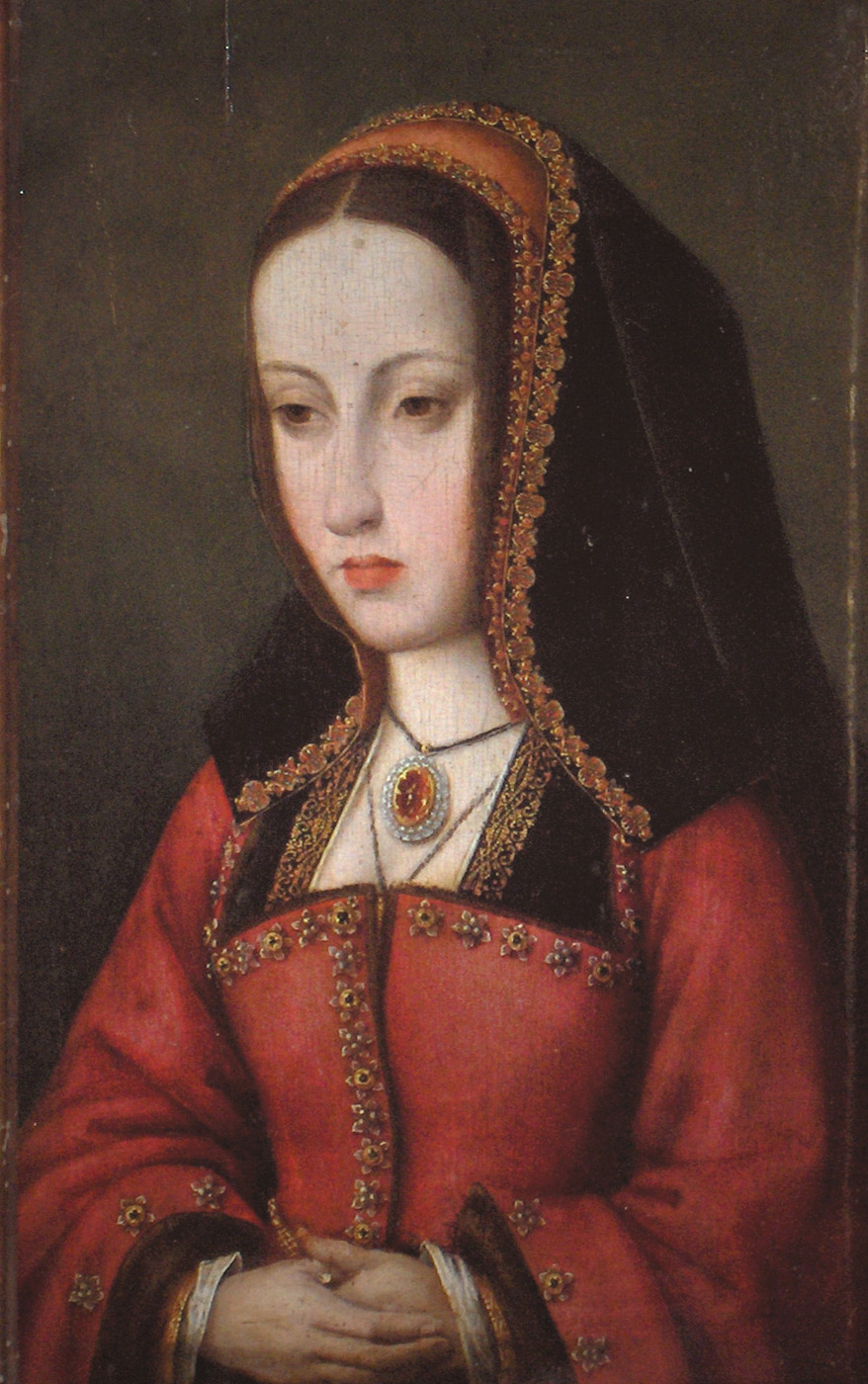 |
Joanna looking a lot like her sister,
Catherine of Aragon
|
Joanna of Castile (1479-1555) became Princess of Asturias upon the death of her nephew Miguel da Paz of Portugal in 1500 (see Isabella of Castile). The second daughter of Ferdinand and Isabella, she was married at age 16 to Philip the Handsome, son of the Holy Roman Emperor, who longed to add Spain to the Habsburg Empire. Joanna was madly in love with Philip, although her passion seems to have been unrequited. Upon her mother's death in 1504, Joanna became Queen of Castile with both her father and her husband claiming the right to rule with her as King. The popularity of Philip and Joanna, forced Ferdinand to withdraw his claim--but the treaty between Ferdinand and Isabella asserted that Joanna was mentally unstable and consequently unable to rule. When Philip died soon thereafter, Joanna attempted to take control but was not able to manage a kingdom that was beset by both plague and famine. Ferdinand seized power against her wishes. When Ferdinand died in 1517, Joanna's teenage son took over as co-monarch with his mother, while she remained confined due to her alleged madness. Having been dominated successively by her husband, father, and son, Joanna lived to have one of longest reigns of any female monarch. (See my post
Long May She Reign.) She is remembered as Joanna the Mad or Juana La Loca.
Isabella Clara Eugenia of Spain (1566-1633) was heir of her father King Philip II of Spain for three years between the death of her older half-brother in 1568 and the birth of her younger half-brother in 1571. She once again assumed the position on the death of her father and accession of another younger half-brother, Philip III, for three years until the birth of his first child. When her maternal uncle, King Henry III of France was assassinated, the Parlement named her the legitimate sovereign of France, despite France's adherence to Salic Law, which forbade female succession rights. However, the issue was much complicated by the religious turmoil and long-ranging dynastic issues, with the nearest male-line heir eventually converting to Catholicism and assuring himself the throne. Isabella married an Austrian archduke when she was 33 and her father granted them to reign over the Spanish Netherlands together. After Albert died, Isabella became a Sister of the Third Order of St. Francis, but continued as governor of the Netherlands until her death in 1633.
.jpg)
Anne of Austria (1601-1666) was the eldest child of King Philip III. Born and raised in Spain, she was called "of Austria" because of the Habsburg dynasty's primary territory. She remained her father's heir until the birth of a brother, the future Philip IV, when she was three. At 14, she married King Louis XIII of France, and was largely ignored at the French court where her mother-in-law reigned supreme and Anne clung to her Spanish friends and Spanish ways. As Louis seized control away from his mum, Anne's Spanish ladies were replaced with French and she began to adopt French manners. However, she suffered several stillbirths, remaining childless for the first 22 years of her marriage, while Cardinal Richelieu held sway over the king. The birth of the future King Louis XIV was greeted as a miracle, and secured Anne's future in France as his regent when her husband died four and a half year's later. She, however, relied upon Cardinal Mazarin as chief minister and he was eventually rumored to be her lover, perhaps even her secret husband. Her regency ended when her son came of age in 1651. Some years later she retired to a convent that she had founded years earlier and died there of breast cancer at age 65. She is a central figure in the Three Musketeers novels, which include the storyline that Louis XIV was not only the love child of Anne and Mazarin, but that he had a secret twin, who was kept hidden until he was brought forth to usurp the king's place, sending Louis to finish his days as the "Man in the Iron Mask".
Maria Margaret of Spain (1621-1621),
Margaret Maria Catherine of Spain (1623-1623),
Maria Eugenia of Spain (1625-1627) and Isabella Maria Theresa of Spain (1627-1627) were the first four children of King Philip IV. They each served as their father's heir, although they lived sometimes for barely a day. His first male heir, Balthasar Charles, was not born until 1629, and he died of smallpox at the age of nearly 17, sending their father scrambling for a new wife to get more sons.
Maria Theresa of Spain (1638-1683) was a younger sister of the four infantas above. She became the heir upon the death of their brother Balthasar Charles, and held the position until the birth of a younger half-brother Philip Prospero and again for the five days between his death and the birth of her half-brother Charles II and again when he became King Charles II in 1665. She was the first wife of King Louis XIV of France. She found an ally there in the person of her mother-in-law, who also happened to be her aunt Anne of Austria (see above). However, Maria Theresa was viewed as somewhat frivolous. She quickly became pregnant and soon gave birth to Louis the Grand Dauphin. From that point, her once faithful husband, no longer remained loyal and she was forced to endure the ever growing influence of his mistresses at court, although he did insist that she be treated with some measure of the respect due to her position as queen. She went on to have five more children, four of whom died as infants and one of whom lived to be five. Although Maria Theresa should have remained the legitimate heir of her childless brother, King Charles II of Spain, the Spanish did not wish to allow France to take control and instead declared that the young son of his full sister Margaret Theresa would succeed him. When that child predeceased him the throne passed to Maria Theresa's grandson, despite the War of Spanish Succession, thus bringing the Borbon dynasty, that reigns in Spain today, to power there.
Maria Luisa Isabel of Spain (1817-1818) and
Maria Luisa Isabel of Spain (1818-1818) were the two eldest daughters of King Ferdinand VII. His wife died giving birth to the second daughter, who having been stillborn, was given the same name as her sister who had died earlier in the same year.
Isabella II of Spain (1830-1904) was the first of the two daughters King Ferdinand VII had with his fourth wife. Isabel was Princess of Asturias for just under three years, when she succeeded to the throne upon the death of her father. However, the Borbon dynasty had brought Salic Law to Spain with them, banning female succession rights. Since he had only daughters, Ferdinand had had these set aside but his brother Carlos contested Isabella's accession, leading to several Carlist Wars during her reign. She always had to rely on the army in order to assert her authority. Her marriage to her double first cousin also caused trouble because his rumored homosexuality led many to whisper that none of her nine children were legitimate. Her reign was rife with palace intrigues and other troubles, and she was eventually deposed in favor of a republic, which fell after four years, restoring her son Alfonso XII to the throne. She left her husband and lived the last three decades of her life in France, although she continued to meddle and cause problems in Spain.
Luisa Fernanda of Spain (1832-1897) was the heir of her older sister Isabella II from 1833 until the birth of Isabella's daughter Maria Isabel in 1851, with a break in 1850 during the brief life of Isabella's first son. Luisa Fernanda was married at age 14 to a French Prince Antoine Duke of Montpensier, who continually conspired against the queen. In 1848, her French father-in-law was deposed from his throne, and she gave birth to the first of her nine children.
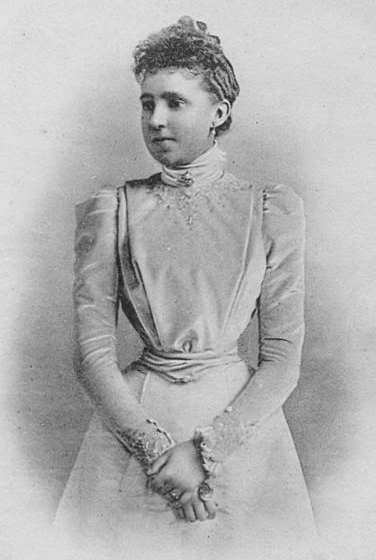
Isabella of Spain (1851-1931) was Princess of Asturias from her birth until the birth of her brother Alfonso XII in 1857, and again was heir from his accession in 1874 until the birth of his first child in 1880. At the age of 16, she married into the Sicilian branch of the family. Isabella was richer, smarter, and healthier than her husband. He suffered from depression and attempted to kill himself on more than one occasion, finally succeeding with a gunshot wound to the head, leaving Isabella widowed at age 20. During her widowhood, she devoted herself to her family and always refused to remarry. She lived through the restoration of the monarchy in Spain and died just five days after it was once again overthrown in 1931.
Maria de las Mercedes (1880-1904) was her father Alfonso XII's heir from her birth until his death on November 25, 1885, at which time she became the extant head of state until the posthumous brother on May 17, 1886, when she again reverted to being the heir. Like her aunt Isabella, she married into the Sicilian Bourbon family, but hers was a love match from the start. Her first child was born nine months after the wedding with another quickly following. The third pregnancy followed within a year, but she fell victim to misdiagnosed appendicitis just days before her due date. During the birth, so much attention was paid to Mercedes that everyone thought the child was stillborn--the baby's uncle King Alfonso XIII was the first to realize the baby was alive. Mercedes, however, died the next day at the age of 24. Her children were raised in the Spanish court while her husband remarried and fathered four more children. One of his daughters was the mother of King Juan Carlos, father of the current King Felipe VI.
Leonor (2005- ) is currently the Princess of Asturias but because Spain has not adopted gender-blind succession laws for the throne (although they do have them for noble titles), she could be supplanted as the heir if her father were to have a son. It is the same position the two current reigning Queens (Elizabeth II of the UK and Margrethe II of Denmark) were in during their years as heirs, even though they grew up two generations ago! The last year or so has been truly momentous for Leonor. Not only did she get her new title and step up to first in line, but she also partook in her first communion.
_-_Cath%C3%A9drale_Saint-Pierre-et-Saint-Paul_de_Nantes.jpg)




.jpg)


.jpg)