29 January 2011

A Royal Love Triangle: Eddy, Georgie and May


No one could believe what was happening. Just days before, the handsome, young prince had gone out shooting, jauntily waving his hat at his beloved mother as he made his way into the January weather. Now, he lay at death’s door surrounded by his parents, his siblings and his new fiancée.

Prince Albert Victor of Wales had been both a joy and a source of despair for his parents since the moment of his premature birth in 1864. At barely three pounds, he would have surprised no one by dying as an infant. Instead, for the first but only time in his life, he showed a remarkable tenacity and determination. Named in honor of his grandmother Queen Victoria and her late husband Prince Albert, the newborn was nicknamed Eddy by his parents, Bertie and Alix, the Prince and Princess of Wales. Eddy was destined to become King of England, but the only qualifications he had were royal blood, insouciant charm and a handsome face.

In all other ways, Eddy was a disappointment. He lacked any intellectual capacity which was only enhanced by an inherent laziness. Victoria and Albert had fretted over Bertie’s seeming lack of intelligence, but next to his son, Bertie was a paragon of learning. Eddy was joined in the classroom by his little brother Georgie and in the playroom by three adoring little sisters, Louise, Maud and Toria.

Full of fun themselves, the Prince and Princess of Wales indulged their children’s playfulness, even joining them in their games. For the Wales children, childhood was a time for sunny romps, giggles and joy. So what if the tutors were frustrated beyond belief? There was more to life than learning.

Once it was clear that Eddy would never accomplish anything in the schoolroom, it was decided to send him into the navy. He was 13 years old. Concerned that he couldn’t hack it on his own, the family sent 11-year-old Georgie with him. Together, the young princes traveled around the world. While Georgie thrived, Eddy floundered. So, he joined the army to even less success. Then, he was sent to Cambridge University where he “earned” a degree.

Eddy excelled at only one thing: dissipation. He could not resist a pretty face (of either sex, it is alleged). Even his partying papa recognized that something had to be done. Afraid to send him abroad where he might encounter more sexual escapades and contract more sexually transmitted diseases, Bertie decided that Eddy needed “A good sensible wife – with some considerable character is what he needs most – but where is she to be found?”

Eddy fell in love easily and would gladly have married any number of lovely young ladies had they been deemed suitable. Resigning himself to a royal bride, he cheerfully fell for his cousin, the lovely Princess Alix of Hesse. Queen Victoria found Alix cheerful and sensible, in short, a perfect bride for a prince who needed both beauty and guidance from his wife. Alix, however, already had a bridegroom in mind. She turned down a future as Queen of England to become Empress of Russia. Victoria applauded the fortitude it took to turn down “the greatest position there is.”

When another first cousin, Princess Margaret of Prussia proved even unattractive, Eddy found his own royal candidate, Princess Helene of Orleans, daughter of the pretender to the French throne. They defied a disapproving Queen Victoria and became engaged without her knowledge. With a surprise visit to the romantic old queen, the gorgeous young couple soon changed her mind, but Helene’s father was not so easy to gainsay when he learned that the Roman Catholic princess would be required to convert.

Denied a bride once again, Eddy was rapidly running out of potential mates. The family would have to dig deeper into their cousins to find the right girl: beautiful enough to attract the prince, level-headed enough to keep him on the right track, dutiful enough to make a good queen, and willing enough to say yes.

Princess Victoria Mary of Teck fit the order perfectly. Despite the fact that her high-spirited mother Princess Mary Adelaide of Cambridge was not a favorite first cousin of Queen Victoria and her father the Duke of Teck was a serene rather than a royal highness, the young princess was stable and calm. May, as she was known, was re-introduced to Eddy and his charms soon had an effect on the princess. On one magical evening, following a royal ball, Eddy asked for her hand and May agreed.

Just weeks later, a solemn and heart-broken princess sat hand-in-hand with the distraught and overwrought Princess of Wales as the family watched the prince slipping away. Lost in delirium, a case of flu having developed into pneumonia, Eddy shouted and cried out for old friends and old flames. May certainly heard him calling, “Helene! Helene!” At one point, he even became convinced that Georgie, who had recently recovered from typhoid fever, was dead

The entire Wales family—even the worried parents—had truly adored Eddy. His brother Georgie, his best friend in the world, was now required to take his place as future King of England.


“Gladly would I have given my life for his, as I put no value on mine,” Georgie wrote to Alix. The effusive Queen Victoria added her own grief to the tragedy, “a great calamity has befallen us as well as the Country.”

As Bertie returned again and again to the death chamber, unable to fully realize the loss of his son and the Princess of Wales ordered that his room be kept just as if Eddy were about to return at any moment, his quiet fiancée faced an uncertain future.

Already in her mid-twenties, she was a bit older than the average princess bride and she did not have the most stellar royal bloodlines. Grief-stricken as she was by the loss of the dashing prince and the loss of her brilliant future, May also may have felt a niggling, guilt-ridden sense of relief. During the brief engagement, she had started to realize that Eddy had less than sterling qualities, but her concerns were rebuffed by her family. Better, perhaps, a glorious future as Queen of England with an unreliable husband than a future as a penniless spinster princess.

Now, there were even more enormous pressures on May. Quite literally everyone from the Queen to the chimney sweeps thought it would be a grand idea if bereft princess would marry the grieving new heir to the throne. It would not be the first time a royal bride had been asked to transfer her affections in this way. There were only two problems; one was named Georgie and one was named May.

The couple was less than enthusiastic about the idea. Not that they didn’t like each other; they did. In fact, they developed a solid friendship through their shared grieving. But, Georgie and May were each the very epitome of English-ness when it came to what was “proper” and to expressing emotion. They each were not convinced that it was entirely seemly for a man to marry his dead brother’s girl.

With time, however, the growing affection between them and the external pressure finally convinced Georgie to propose and May to accept. Sixteen months after Eddy’s death, the couple was married and less than a year later, they named their first son Edward in memory of the joyful wastrel whose death had brought them together. 

16 January 2011

Eleanor's Crosses: A Royal Love Story

For two days, the mighty king remained in seclusion. Pale and withdrawn, stricken with an overwhelming grief that distracted him from the impending war with Scotland. For 36 years, Eleanor of Castile had been the faithful and loving companion of the powerful King Edward I. Unlike most royal marriages in history, theirs was a true love story.

Initiated for political reasons designed to shore up the southern reaches of what remained of Henry II’s and Eleanor of Aquitaine’s Angevin empire, the marriage between their great-grandson and the Castilian king’s darkly beautiful sister was immediately successful. Handsome, tall and blonde, like all the famous Plantagenet princes, Edward was 15 when they wed while his bride was a dewy-eyed 13.

Eleanor became pregnant with alarming haste, but both of the extremely young parents were distraught when the pregnancy ended tragically. Perhaps filled with fear for Eleanor’s life, the couple apparently engaged more cautiously for the next several years and their first child, a daughter named Eleanor, was not born for another nine years. From that point forward, they were indeed very fruitful with 16 children born in 25 years.

This reproductive success certainly reflects the couple’s devotion to each other, but it was also made possible by their constant togetherness. In an age when royal spouses were often separated for months and even years as the husband pursued his territorial claims, fought off attackers, and journeyed on The Crusades, Edward and Eleanor rarely allowed space to come between them. Even though Edward’s court was in almost constant motion, sometimes staying in one place for no more than a day or two, Eleanor was usually with him.

Even in the late stages of her many pregnancies; she could not be persuaded to leave her beloved husband’s side. Her children were born all over the world of her day as she followed Edward from campaign to campaign. Sometimes arriving in stalwart castles other times in makeshift accommodations, her infants were born at Windsor, Surrey and Woodstock in England, at Rhuddlan and Caernarvon in Wales, and in Gascony and Palestine.

Like her predecessors Eleanor of Aquitaine and Eleanor of Provence, Eleanor would not be left behind when her husband, who was not yet king, went on Crusade. During that journey, she nearly lost her husband, not in battle but at the hands of an assassin. Under the pretense of diplomacy, the culprit entered Edward’s tent and pulled out a knife. Ever vigilant and athletic, the prince personally fought off his attacker and killed him with his own knife, but not before suffering a defensive wound on his arm. The poisoned blade soon left Edward near death. Later stories circulated of Eleanor sucking the poison from his wound in a brave display of her devotion. The true story, however, also shows the depth of her passion. The doctors were forced to remove the hysterical Eleanor from the tent before they could operate: better that a princess should cry than that all of England should mourn.

Hale and hearty, Edward survived and the couple returned home to be feted as the new king and queen since his father had died in their absence. To show his love and respect for his queen, Edward had Eleanor crowned with him in the first double coronation for centuries.

As the year’s progressed, Edward and Eleanor never tired of each other. He is one of the few medieval monarchs believed to have been entirely faithful to his wife. She was with him on his journey north in November 1290 to deal with another batch of trouble with the Scots. She remained at Harby near Lincoln as he made the final push toward the frigid border. Eleanor fell terribly ill and word was sent to Edward who, forgetting the urgency of his mission, rushed to her side. But, he was too late.

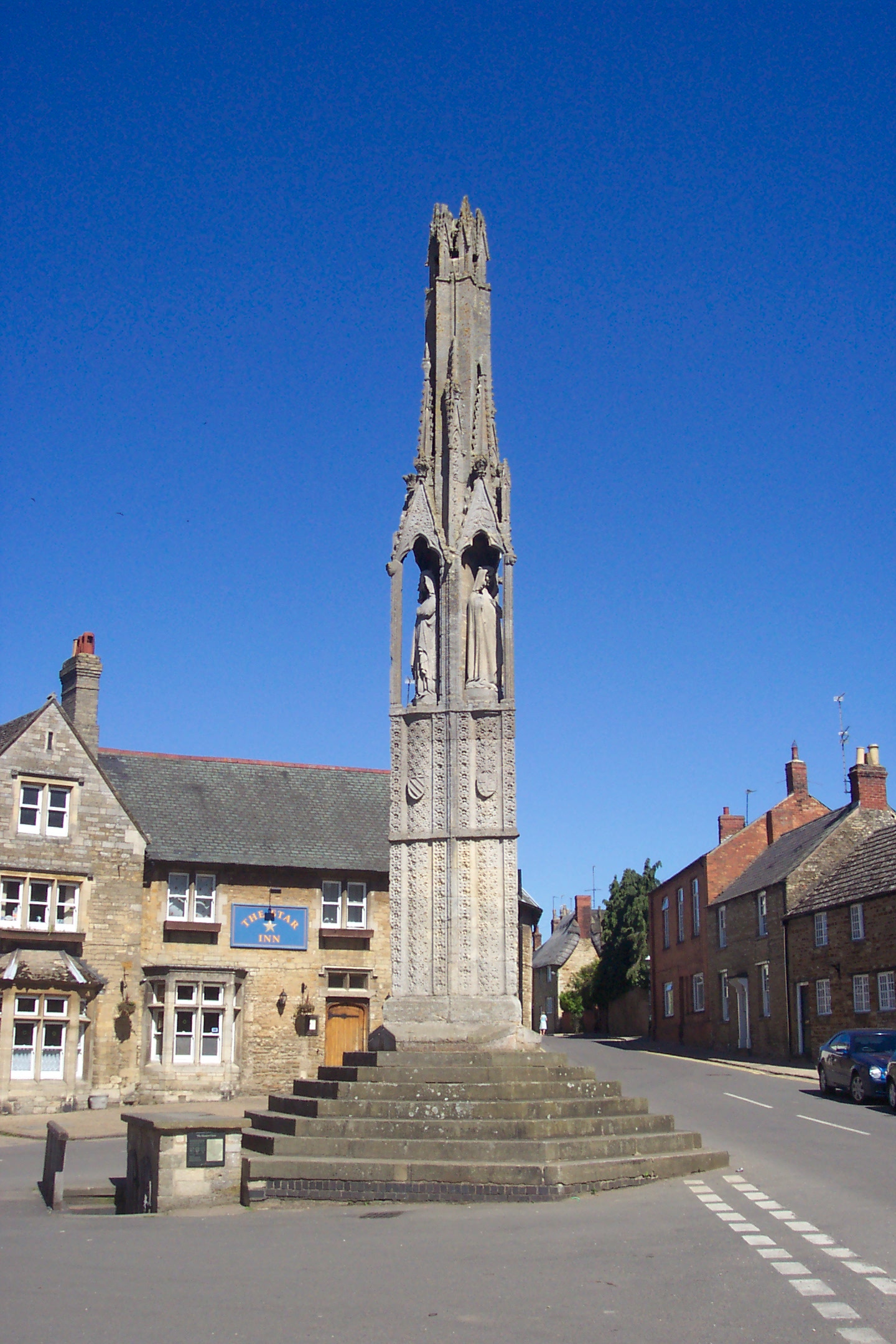
And so, he sat alone with his grief. How could he honor a wife of 36 years? After so many children and so many decades, her celebrated beauty may have faded, but as the saying goes, beauty is in the eye of the beholder. Edward could not forget his bride and would ensure that she was remembered for centuries. As her cortege made its slow journey to London, her widower erected a cross at every place where it stopped for the night. Originally made of wood, each marker was replaced with an elaborate stone sculpture topped with a large cross. Each one included three brightly colored and gilded tiers. The lowest level included stone books likely inscribed with tales of the queen’s life and prayers that passersby were encouraged to recite for her soul. The next level included sculptures of the queen herself.


Edward spent the equivalent of millions of dollars in today’s money to erect 12 “Eleanor Crosses” from Lincoln to Charing. Carved in the same ornate style that the king’s architects were using in Westminster Abbey, the crosses stood taller than most contemporary buildings at the crossroads where they were most likely to be seen. For the rest of his long life, Edward continued to attend services honoring Eleanor, even after he married again for political reasons.

Unfortunately, the Eleanor Crosses did not weather well the mists of time and politics. They were all made of stone that eroded, except the final cross at Charing, which was made of marble. But even Charing Cross could not stand against the Parliamentarian Roundheads of the English Civil War. It, like most of the crosses, was destroyed by the Puritans who viewed the Catholic crosses as idols. Today, only three of Edward’s memorials remain standing—at Geddington, Hardingstone, and Waltham—although each of these no longer bears the cross at its apex. Pieces from some of the crosses have been preserved or even restored by their local communities.

As for the elaborate monument which now stands in front of the Charing Cross rail station; it is a less-than-accurate replica constructed there in 1865 as a marketing device to advertise the new Charing Cross Hotel.

The crosses may have lost their golden shine or been toppled in the seven centuries that have intervened, but Edward’s tender tribute to Eleanor still echo: “We cannot cease to love our consort, now that she is dead,” he wrote, adding, “whom we loved so dearly when alive.”

For more about the Eleanor Crosses, visit the Art & Architecture feature.

13 January 2011

Become a Certified Royal Expert

The Princess Palace is pleased to announce the creation of its sister blog, Royal Certification. This is a tongue-in-cheek (hopefully fun!) response to the proliferation of so-called "royal experts" being quoted by the media. All of you royal geeks out there can indulge your love of royal trivia with me!