31 January 2015

Today's Princess: Louisa Maria La Coast

Louisa Maria's father
By British School via Wikimedia Commons

If King George III truly was mad, perhaps it was because of his brothers and sons drove him to it. None of them wished to marry properly and many of them were kept quite busy fathering illegitimate children. Case in point, George's younger brother William Henry Duke of Gloucester made an inappropriate marriage with the illegitimate granddaughter of a politician. However, George didn't even know about it until six years later, when he passed the Royal Marriages Act in an attempt to prevent such marital mishaps.

William Henry's "love match" didn't prevent him from straying, which brings us to today's "princess": his illegitimate daughter Louisa Maria La Coast. William Henry had fallen for one of his Duchess's ladies-in-waiting, Lady Almeria Carpenter. After the birth of her daughter in 1782, Almeria stayed on as a permanent third wheel in the royal marriage, even traveling with the couple to fled to live on the continent for financial reasons--another downfall of George's brothers and sons.

Meanwhile, little Louisa Maria was raised on a dairy farm by her father's steward. When she was old enough, she ran off with Godfrey Bosville Macdonald, who later became the 3rd Baron Macdonald of Slate. The couple didn't marry under English law, instead they simply pledged themselves to each other, which was good enough in Scotland, where they were living. The first three of their 13 children were born, therefore, without being legitimate according to English law. When they finally married, they seem to have hidden this fact from the children. It is said that eldest son Alexander had lived in expectation of inheriting his father's title. He was dining at a neighbor's house when word reached the dinner party that Baron Macdonald had died. As he prepared to withdraw with haste, his cruel hostess ordered him to sit back down, saying, "You are not Lord Macdonald." With this rude awakening, he learned the secret of his birth and that his younger brother, born after his parents' legal marriage, was now the 4th Baron Macdonald.

Louisa Maria died in 1832.

30 January 2015

Today's Princess: Ulvhild Hakansdotter

Vreta Church where Ulvhild is said to have poisoned a King
By Hedning via Wikimedia Commons
To paraphrase Lionel Ritchie, today's princess was once, twice, three times a queen. The infamous Ulvhild has a reputation as something like a combination of Lady Macbeth and Jezebel for medieval Scandinavia. She married three kings, she mothered another, and she may have killed another.

The daughter of a powerful Norwegian family, she married her first king, Inge II of Sweden, when she in her early 20s. Inge, however, was not powerful enough for her: he shared his throne with his brother King Philip. He apparently wasn't "enough" for her in general because she was also known to have a lover. So, when Philip turned up dead a year or so after her marriage, rumors abounded that he was poisoned by Ulvhild and her lover.

The dates of Inge's death are unclear, but he did not survive much longer. His widow fled to Denmark for safety--not sure why she didn't go home to Norway (wonder what she may have already done there?) Fortunately for her, the Swedish Queen Margaret Fredkulla, died a few years after her arrival and Ulvhild picked up her second crown by marrying King Niels of Denmark.

Scandinavia was in an almost constant state of war during the 12th century, so this marriage didn't last much longer than the first. Niels and all of his companions were slain in Schleswig as they sought refuge following the Battle of Fotevik, where Niels' son Magnus Nilsson died trying to defend his rights as Sweden's king and his inheritance right to the Danish throne.

However, some sources think Ulvhild had already left Niels to flee back to Sweden, where she married the new King Sverker I, who replaced Niels' son on that throne. (Are you keeping up? These are a lot of kings in a short timespan.) This marriage is the only one that seems to have produced children although how many children is not entirely clear. There were perhaps five. Of these, the only ones who are well-documented are the future King Charles VII of Sweden and a daughter, probably named Helena.

Ulvhild remained with Sverker until she died in her early fifties. He then married Richenza of Poland, the widow of Ulvhild's stepson Magnus Nilsson, whom Sverker had replaced on the Swedish throne. Richenza in the meantime had been married to the Prince of Minsk. In return, Sverker helped secure the Danish throne for her son by Magnus, who by the way was married to Ulvhild and Sverker's daughter Helena.

It is a tangled marital web worthy of a telenovela or reality television.

29 January 2015

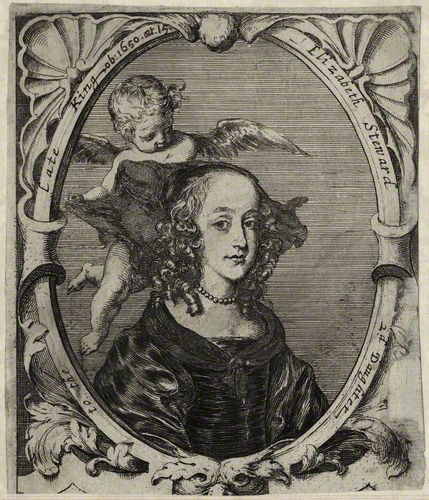
Today's Princess: Elizabeth Stuart

via Wikimedia Commons
Many princesses have been caught in the midst wars and several have been held as prisoners in conflicts well beyond their control. Madame Royal in France. The Grand Duchesses in Russia. And today's princess, Elizabeth Stuart, daughter of the beheaded King Charles I of Great Britain.

When the English Civil War broke out, what once had been a close and unusually loving royal family was physically split up. The five surviving children of Charles and his French Queen Henrietta Maria would never be all together again. (A sixth child, Henrietta Anne would be born in the midst of the war.) Elizabeth was six years old. Parliament took over custody of her and her younger brother Prince Henry Duke of Gloucester and insisted that they be reared as Protestants in contrast to their Catholic family. They were shifted among various locations over the years, sometimes joined by their older brother The Duke of York (later King James II). Frequently, they were an unwanted burden for their caretakers.

Nevertheless, Elizabeth received an excellent education. She was particularly well-versed in religion and was able to read and write in many languages, including Ancient Greek, Latin, Italian, Hebrew, and French. She frequently wrote eloquent letters to request changes in her treatment. At age 12, she wrote to request that her household (her servants) not be removed from her, as had been planned. Parliament relented, allowing her to keep her quasi-family around her.

Renowned for her sweet and calm temperament, Elizabeth struggled with health issues. Centuries later, her body was examined and found to have suffered from rickets, knock knees and pigeon toes. These deficiencies led to at least one seriously broken leg.

Her most heartbreaking moment came when she and Henry were allowed to say goodbye to their father as he awaited execution. They had seen him periodically over the years, and loved him dearly. Twelve-year-old Elizabeth stoically recorded as many details of their final meeting as she could remember. He sent his love to their mother, encouraged them to be good Protestants, and warned young Henry not to become a pawn king in the hands of Parliament: do not let them crown you while your older brothers live.

The sobbing children were led away into an even worse political situation. No longer children of the king, they were at the mercy of their guardians, who could not treat them very well lest they be seen as committing treason against Parliament. When their oldest brother swept into the country to have himself proclaimed king against Parliament's wishes, it was decided to move Elizabeth and Henry to the distant confines of the Isle of Wight. Elizabeth, ill at the time, wrote again to Parliament begging not to be moved because of her health. Her pleas went unheard. After the move, she developed pneumonia and died. She was 14.

For two centuries, her grave was marked simply by her initials, E.S., until Queen Victoria made the Isle of Wight her main home. She erected a monument depicting the young Princess, whose dead body had been found resting on the Bible that her father had given her during their last tear-filled meeting.

For more about Elizabeth:
Elizabeth Stewart - The Lost Princess on Madame Guillotine